When hearing problems are identified early and treated, the results are far more successful. Early treatment and training reduce the developmental problems that hearing loss brings. It is needed because:
- The first three years of life are the most critical stage for learning language. If the sharing of feelings between parents and child is disturbed at this stage, language development stops.
- Without early identification, treatment, amplifying devices and assistive devices, students with hearing loss cannot learn spoken language and are left isolated.
- Even fluctuating hearing hinders the development of the child's auditory mechanism and the processing of speech sounds; this gap shows up as major learning problems when the child starts school.
Who is at higher risk?
- 3 to 25% of babies born with low birth weight may have mild to moderate hearing problems; a small percentage (about 1.3%) have severe or profound problems.
- Illness in the newborn period and early use of drugs that are toxic to the ear can cause hearing problems in childhood. So a single screening test in the neonatal ICU (NICU) cannot catch every problem.
- Frequent ear infections cause fluid in the ear and a conductive loss; a chronic infection can also cause permanent damage. Intermittent hearing loss and repeated infections also hinder conversation and language development.
- Children with a partial loss are hard to assess - even a loss that is only at some frequencies, or mild, hinders speech development.
Newborn hearing screening
- The American Academy of Pediatrics recommends universal screening of all newborns for hearing loss, and repeated screening tests for children at risk of hearing problems that appear later. Any child suspected of having a hearing loss should have an audiological test.
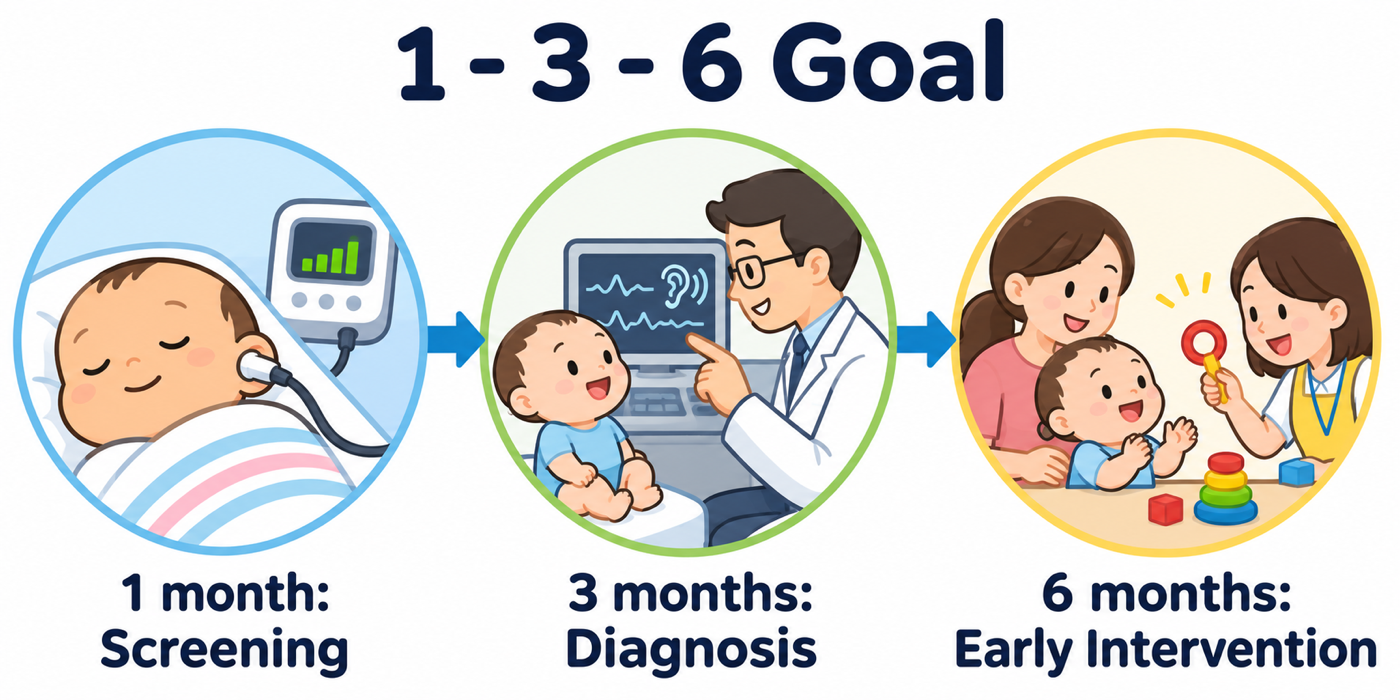
- The internationally followed "1-3-6" goal: screening by 1 month, diagnosis by 3 months, enrolment in early intervention by 6 months.
- Screening is usually done in two stages: first an OAE test, and if the baby fails it, BERA (details of these tests in the next topic).
- In our country, newborn hearing screening is part of the Rashtriya Bal Swasthya Karyakram (RBSK).
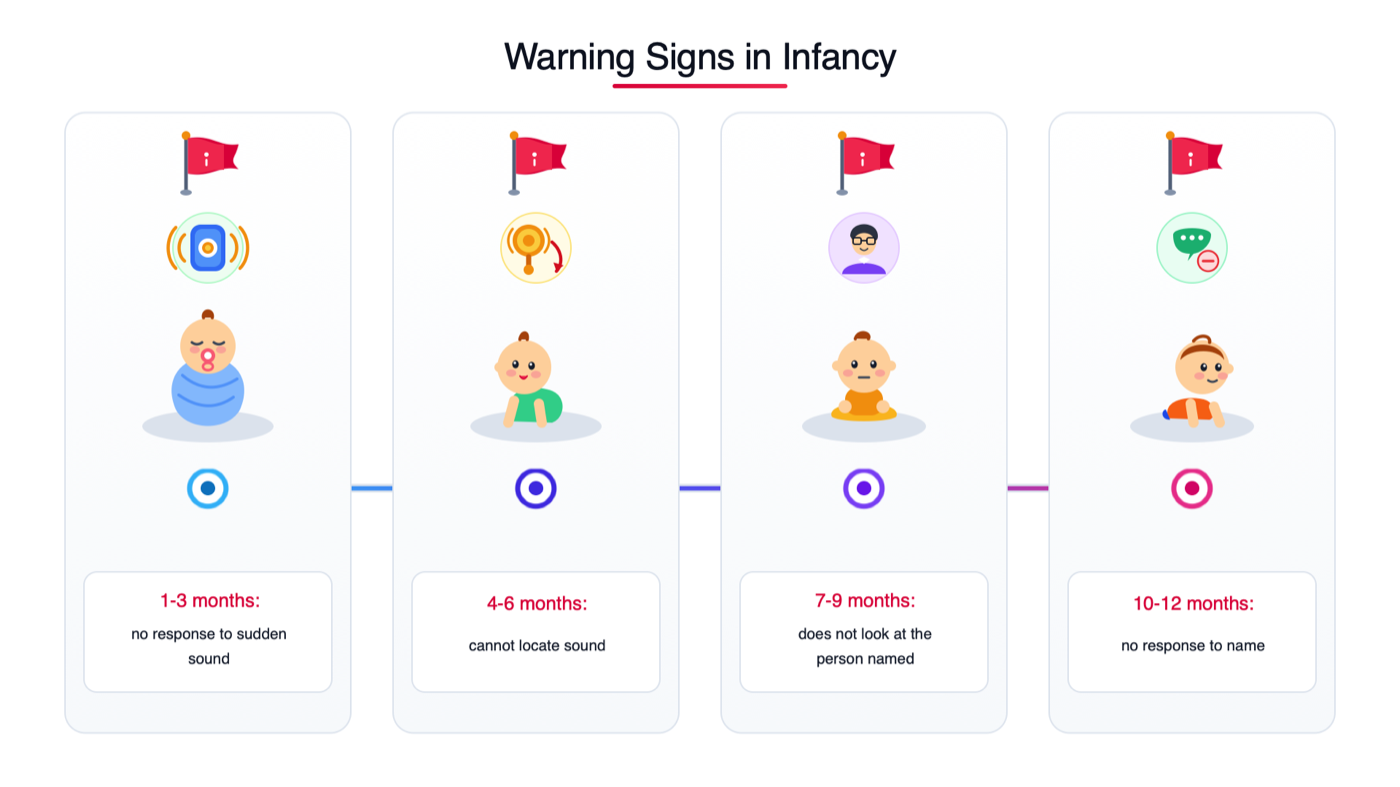
Warning signs in infancy (age-wise)
| Age | The expected response is missing |
|---|---|
| 1-3 months | No response to a sudden sound such as a door slamming or a doorbell |
| 4-6 months | Does not locate where a sound is coming from |
| 7-9 months | Does not look towards the person when asked "Where is Daddy?" |
| 10-12 months | No response when the name is called, or to often-used words such as "come" and "go" |
Behaviours that suggest a hearing problem
In infants:
- Does not respond to sounds; follows visible events but does not notice sounds.
- Does not babble, or babbles for a while and then stops.
- Does not respond to his name in early childhood.
- Any delay in development, lag in language skills.
- Unusual voice quality; unusual articulation errors when saying words.
In childhood:
- Responding late to sound; not hearing others' speech clearly; unable to tell where a sound is coming from.
- Paying more attention than usual to the speaker's facial expressions and lip movements while listening.
- Giving unrelated answers, misunderstanding instructions; asking for things to be repeated in conversation.
- Understanding speech is even harder in noisy places; turning up the TV volume.
- Wrong pronunciation, delayed language development, poor attention in class.
- Frequent use of gestures, such as pointing at what he wants; getting irritated easily when he cannot understand speech.
- If unusual behaviour or poor attention is seen at school, the cause should be looked into at once - hearing loss may be the reason.
If these signs are seen, parents should be alert and take medical advice as early as possible.
Some tips for parents
- Babies with hearing loss need what every child needs: the parents' love, patience and attention.
- When talking to the baby, make eye contact; facial expressions and gestures should match what is said.
- If the parents talk about the hearing loss openly from the start instead of hiding it, it is easier for them, and later for the child, to accept it naturally.
- During the speech-learning stage: treat the child as normally as possible; speak clearly; teach him to look at the speaker; if he does not understand, say it again in other words; encourage him to ask about what he does not understand; keep background noise low while talking; bring pictures to life with sounds such as animal noises while reading picture books.
- If the child joins a regular school, seat him in the front row; the teacher should use an FM system. Speech / music therapy also improves reading and writing skills. (Details of early intervention and classroom strategies are in the next chapter.)
Exam focus: Early identification gives better results; the first 3 years are critical. Among low-birth-weight babies, 3-25% have a mild-moderate loss and about 1.3% a severe loss. "1-3-6": 1 month screening, 3 months diagnosis, 6 months intervention. Signs: 1-3 months no response to sudden sound; 4-6 months cannot locate sound; 10-12 months no response to name; no babbling / babbling stops; turning up the TV volume; more attention to lip movements.
Memory code: "1-3-6 = S-D-I": 1 month Screening, 3 months Diagnosis, 6 months Intervention. Infant signs "S-D-L-N": 1-3 months no response to Sudden sound, 4-6 no sense of Direction, 7-9 does not Look at the person named, 10-12 no response to Name.