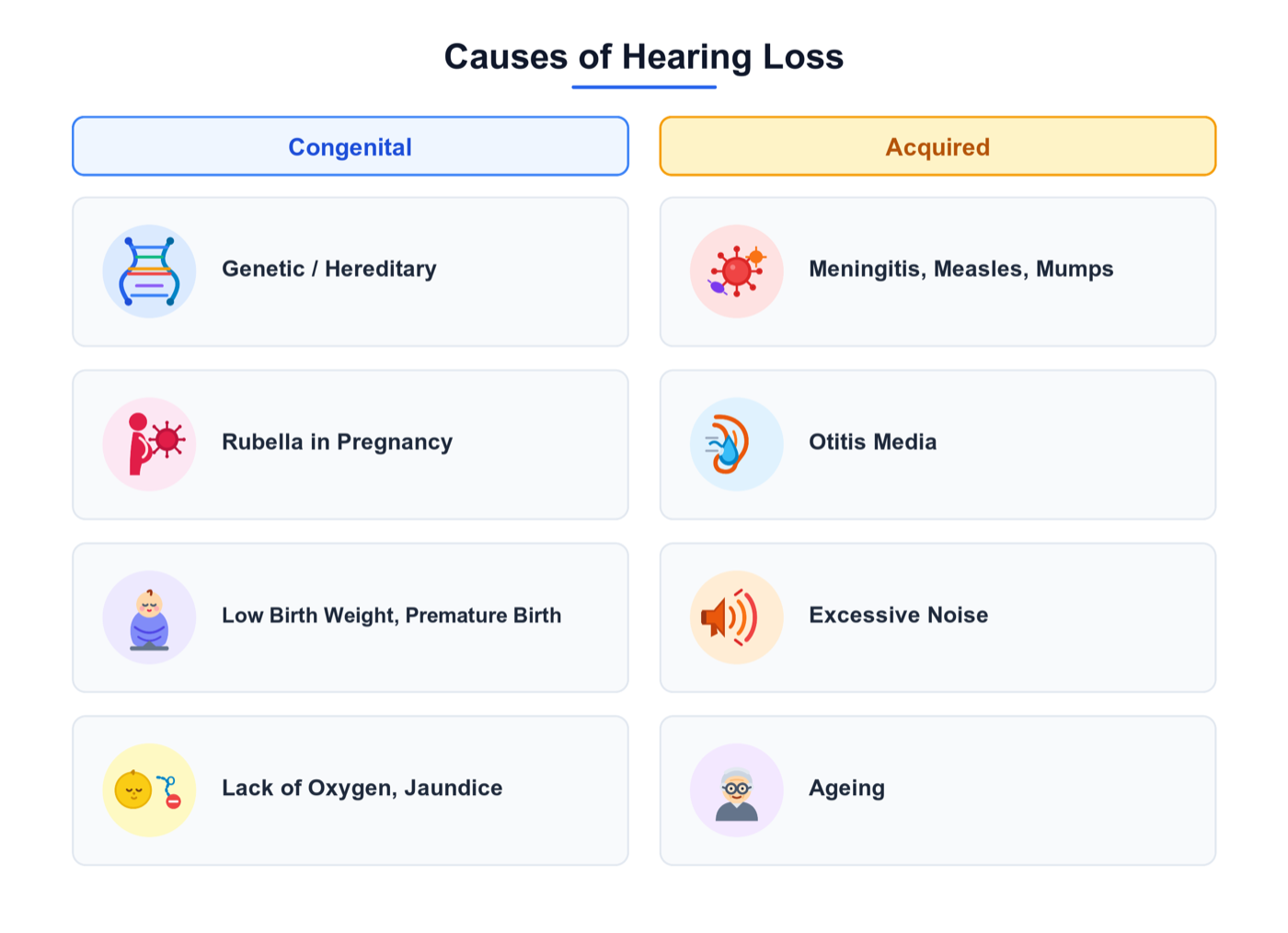
The causes of hearing loss are mainly divided into congenital (present at birth) and acquired (after birth). The three types by site (conductive, sensorineural, mixed) occur in both congenital and acquired loss. It can affect any age, but the great majority of people with hearing loss are elderly.
Congenital causes
A loss present at birth or arising soon after birth. The cause may be genetic/hereditary, problems in pregnancy or problems at delivery.
Genetic causes: more than half of congenital hearing loss is due to genetic causes.
| Type | How it is passed on | Chance for the child |
|---|---|---|
| Autosomal dominant | A dominant gene from one parent is enough; if one parent has the loss, it can be predicted that the child will have it too | At least 50%; higher if both parents have it |
| Autosomal recessive | Both parents carry the gene but both hear normally; since no one in the family has the loss, it cannot be predicted beforehand | 25% |
| X-linked (sex-linked) | The mother carries the faulty trait; she can pass it to both girls and boys | Mainly affects boys |
- Related syndromes: autosomal dominant - Waardenburg syndrome, Crouzon syndrome, Treacher Collins syndrome; autosomal recessive - Usher syndrome; X-linked - Alport syndrome. Hearing loss is also a known feature of Down syndrome.
Causes during pregnancy and delivery:
- Infections in the mother during pregnancy, such as rubella (German measles), syphilis, cytomegalovirus, toxoplasmosis, influenza and mumps. The risk of various injuries to the foetus is highest in the first three months of pregnancy.
- Improper use of certain medicines during pregnancy: aminoglycosides, anti-cancer drugs (cytotoxic), anti-malarial drugs, diuretics; overuse of streptomycin and quinine.
- Low birth weight and premature birth.
- Lack of oxygen at birth (birth asphyxia) - for example, after prolonged labour or when the baby does not cry immediately after birth; instrumental delivery.
- Severe jaundice (high bilirubin) in the newborn period - can damage the baby's auditory nerve.
- Structural defects of the ear, nose and throat; chromosomal abnormalities, drug use by the mother, environmental causes, treatment-related causes and unknown causes.
Congenital structural defects of the ear
| Part | Defect | Details |
|---|---|---|
| Outer ear | Anotia / microtia | Anotia = complete absence of the pinna; microtia = a pinna malformed to some degree (together with a narrowed / absent ear canal). The "small but well-formed ear" seen in Down syndrome is different from this. More often on one side; less often on both sides |
| Outer ear | Macrotia | A large but well-formed pinna; usually no functional problem; rare; can be corrected surgically (Antia-Buch method) |
| Outer ear | Atresia of the ear canal | The ear canal is not formed properly / is closed; a membrane or bony plate in place of the eardrum; there may be bone defects too. Atresia = absence or closure of the ear canal, often with a malformed outer ear (in exam options it may appear as "absence of outer ear"; a missing pinna itself is anotia); middle ear defects are also common in these children; the eardrum and ossicles may be completely absent |
| Middle ear | Eardrum defects | A small eardrum (e.g. congenital rubella syndrome), a deformed eardrum (e.g. VATER syndrome), or fibrous tissue / a bony plate in its place |
| Middle ear | Defects of the ossicles | One or more bones partly / completely absent or fused; surgery corrects this to some extent |
| Middle ear | Congenital cholesteatoma | 2-3% of all cholesteatomas; usually on one side; a white mass behind the eardrum; shows as a conductive loss; a CT scan is advisable |
| Middle ear | Vascular defects, perilymph fistula | A red, pulsating mass behind the eardrum; in a fistula, a fluctuating, increasing sensorineural loss, ringing in the ear, dizziness, and sometimes recurrent meningitis |
| Inner ear | Structural defects of the inner ear | Rare; deafness, dizziness; the cause in up to 20% of children with sensorineural loss. The most common form is cochleo-saccular dysplasia. These children have a higher risk of recurrent meningitis, so middle ear infections must be treated firmly and contact sports avoided |
Previous papers questions asked in the exam on what you just read
Atresia means
- (1)Pain en ear
- (2)Defect in middle ear
- (3)Absence of outer ear
- (4)Foreign bodies in outer ear
Answer & explanation
Correct answer: (3) Absence of outer ear
The question asks the meaning of the term 'atresia' with reference to the ear.
Atresia means that a body passage or opening has not formed at birth or is closed. In the ear it is called aural atresia: the external ear canal is absent or closed, and it often comes together with a malformed pinna (microtia). Because sound has no path to the eardrum, it causes a conductive hearing loss. So the answer is option (3) Absence of outer ear.
Ear pain (1) is called otalgia. Middle ear defects (2) include otitis media and otosclerosis. Foreign bodies in the outer ear (4), such as seeds or beads, are objects put into the ear, not a birth defect.
Remember: Atresia = passage not formed; in the ear, the outer ear canal is absent.
Acquired causes (after birth)
- Infectious diseases: meningitis, measles, mumps, encephalitis, chicken pox, flu, diphtheria, typhoid and whooping cough.
- Chronic ear infections and fluid in the ear (otitis media). The leading cause of hearing loss in children is chronic otitis media.
- Some antibiotic and anti-malarial medicines.
- Injury to the head / ear, accidents.
- Excessive noise (the leading preventable cause): occupational noise such as machines and explosions; recreational noise such as earphones, music concerts, nightclubs and sports events.
- Ageing - especially the degeneration of sensory cells.
- Blocking of the ear canal by wax or foreign bodies.
- Other diseases and conditions: cytomegalovirus, sickle cell disease, AIDS, syphilis, Lyme disease, diabetes (up to 40% of diabetic patients have some type of hearing loss), TB (streptomycin used to treat it can be a key risk factor), an underactive thyroid, arthritis, some cancers; in teenagers, breathing in other people's cigarette smoke.
Causes of conductive loss
- Defects in the outer ear, ear canal or middle ear; blocking of the ear canal by wax, foreign bodies, infection or tumours.
- Fluid in the middle ear after a cold; allergies; poor functioning of the Eustachian tube.
- Otitis media (middle ear infection): when the Eustachian tube is blocked, fluid cannot drain into the throat and collects in the middle ear; this pus / mucus reduces the movement of the bones. Frequent discharge of pus from the ear is a sign of hearing loss.
- Otitis externa (inflammation of the outer ear): germs and fungi make the skin of the ear canal swell, turn red and discharge a little pus. Mild swelling may not reduce hearing, but if the swelling is large it causes a block.
- Hole / tear in the eardrum: sharp objects, pressure from a middle ear infection, a hard slap on the ear, pressure changes in scuba diving. The eardrum is so thin that a doctor can see through it into the middle ear.
- Otosclerosis: fixes the stapes in the oval window and causes deafness.
- Bony growths that narrow the canal after years of repeated exposure to cold water (for example, swimming); harmless tumours; atresia.
Treatment: often cured with medicines (usually antibiotics) and surgery. Examples: myringotomy (a small cut made in the eardrum to drain fluid), tympanoplasty to repair a damaged middle ear, mastoidectomy in chronic otitis media to prevent spread to the brain and meningitis, stapedectomy for otosclerosis, and in some cases fitting grommets. Congenital atresia can be corrected surgically if the inner ear is healthy. Ear doctors (otologists) remove impacted wax and foreign bodies. Hearing aids are also useful.
Previous papers questions asked in the exam on what you just read
Frequent draining from the ear in a child may lead to this Impairment
- (1)Visual Impairment
- (2)Hearing Impairment
- (3)Specific learning disabilities
- (4)Intellectual Disability
Answer & explanation
Correct answer: (2) Hearing Impairment
The question asks which impairment can result when pus or fluid drains from a child's ear again and again.
A discharging ear is a sign of middle ear infection (otitis media). If it is not treated, the ear drum can get a hole and the small bones of the middle ear can be damaged. Then sound is not carried properly to the inner ear, which causes conductive hearing loss. This is one of the common causes of hearing loss in children.
So the answer is option (2), hearing impairment. A teacher who notices a discharging ear should refer the child to an ENT doctor at once.
Visual impairment (1) concerns the eye. Specific learning disabilities (3) and intellectual disability (4) are related to how the brain functions; an ear infection does not directly cause them.
Remember: Discharging ear → damaged ear drum → hearing loss.
Causes of sensorineural loss
- Prolonged exposure to loud sounds - the leading preventable cause of sensorineural hearing loss (the commonest cause overall is ageing, presbycusis). Long exposure to sound of about 85 dB and above damages the hair cells in the cochlea, and the damage shows first around 4000 Hz on the audiogram. This is called noise-induced hearing loss; occupational noise is a major source. People working in such places should wear earplugs or earmuffs.
- Ageing (presbycusis): with age the nerves weaken and the cells of the cochlea degenerate; this is the commonest cause of sensorineural loss overall and the most common loss in the elderly. It is present in about 40% of people aged 65-70. It is mild in some and severe in others.
- Noise-induced loss and presbycusis are both mainly high-frequency losses. In most languages, speech is defined by high-frequency sounds; so these people hear sound but cannot make out speech, especially when there is noise around.
- Head injury; failed middle ear surgery or its complications.
- A virus or disease; autoimmune inner ear disease; brain infections such as meningitis.
- Drugs that are toxic to the ear (ototoxic): aminoglycoside antibiotics (streptomycin, gentamicin, kanamycin, tobramycin) - permanent loss. Salicylates such as aspirin, and quinine, in high doses - a temporary high-frequency loss; long use of high doses leads to permanent deafness.
- Heredity: there is a hereditary form; more than half of congenital loss is genetic. Among infections in pregnancy, rubella (German measles) and, today especially, cytomegalovirus (CMV) are important causes.
- Inner ear malformation, tumours, blocked blood flow to the inner ear.
- Meniere's disease: caused by increased fluid (endolymph) pressure in the inner ear; so it is also called endolymphatic hydrops. Symptoms: hearing loss, ringing in the ear (tinnitus) and dizziness (vertigo). They come as attacks, together or separately.
Treatment: the structure of the inner ear is very complex; once damaged, it cannot be repaired. Hearing aids must be used; children with a congenital or pre-speech loss do not develop speech properly, so the earlier it is identified, the better. For some, aids may not help; for them a cochlear implant can be tried.
Causes of neural and mixed loss
- Neural loss: damage to the auditory nerve and the brain areas that handle hearing - more likely to be permanent. Causes: stroke, multiple sclerosis, acoustic neuroma (a tumour of the auditory nerve).
- Mixed loss: many people have both conductive and sensorineural loss. Example: an elderly man with presbycusis may also get a conductive loss from otitis or otosclerosis. Treatment: medicines, surgery or a hearing aid.
- Tinnitus (ringing in the ear): the ear itself produces extra sounds because of the same disorders that reduce hearing - ringing, whooshing or clicking sounds; no one except the patient can hear them.
Exam focus: More than half of congenital loss is genetic; autosomal dominant - at least 50%, autosomal recessive - 25%, X-linked - mainly boys. Leading cause of hearing loss in children = chronic otitis media. Leading preventable cause of sensorineural loss = prolonged loud noise (85 dB and above; damage shows first around 4000 Hz). Presbycusis = loss due to ageing, the commonest cause overall (about 40% at 65-70). Meniere's = tinnitus + vertigo + hearing loss (endolymphatic hydrops). Atresia = ear canal absent or closed, often with a malformed outer ear (exam answer: "absence of outer ear"). Otosclerosis = fixed stapes; surgery is stapedectomy. Aminoglycosides (streptomycin) are toxic to the ear.
Memory code: Genetic chances "Dominant = Half, Recessive = Quarter, X = boys" (50% - 25% - boys). Meniere's triad "T-V-H": Tinnitus, Vertigo, Hearing loss. The surgery pair "Stapes → Stapedectomy, Tympanum → Tympanoplasty".