To understand hearing loss properly, we first need to know how the ear is built. We should not think that only the ears seen on both sides of the head do the hearing; the parts that matter most for hearing lie inside the head. The ear has three main parts:
| Part | What it contains | Main job |
|---|---|---|
| Outer ear | Pinna (auricle), ear canal (external auditory canal) | Collects sound and sends it inwards |
| Middle ear | Eardrum (tympanic membrane), three small bones (ossicles), Eustachian tube | Carries vibrations to the inner ear and amplifies them |
| Inner ear | Cochlea, vestibular system, auditory nerve | Changes vibrations into nerve signals; body balance |
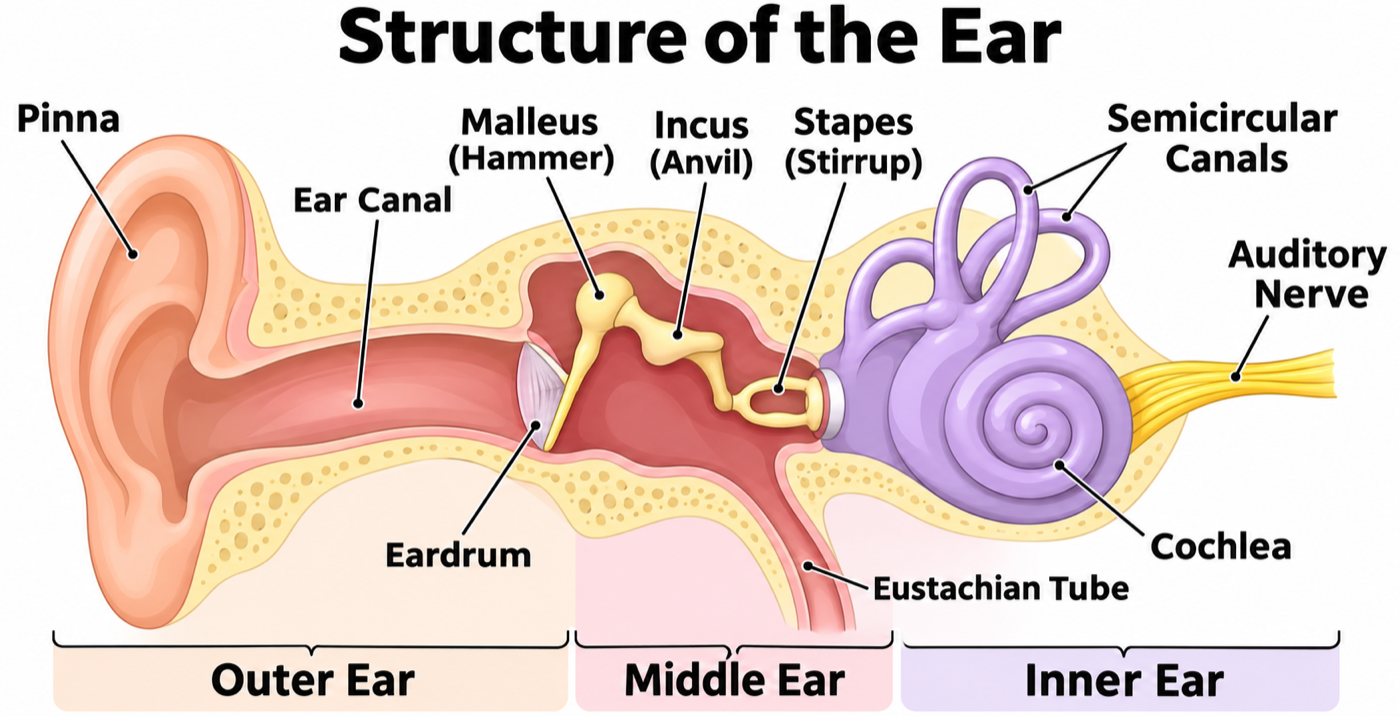
Outer ear
The outer ear has two parts: the pinna and the ear canal.
Pinna (auricle):
- This is the part we can see. It collects sound and funnels it into the ear canal.
- It is cone-shaped and is attached to both sides of the head at an angle of 30 to 40 degrees.
- It is made entirely of elastic cartilage; it has no bones. It has its own blood and nerve supply.
Ear canal (external auditory canal / external auditory meatus):
- An "S"-shaped tube. It opens outside near the pinna and is closed inside by the eardrum.
- In adults it is about 2.5 cm (25 mm) long, with a volume of about 2 cc.
- The outer one-third is cartilage and the inner two-thirds is bone.
- It is lined with skin; the outer part has hairs. It has ceruminous and sebaceous glands, which produce ear wax (cerumen). The hairs and the wax stop germs and dust from getting into the middle ear.
Middle ear
- A small, air-filled chamber of about 2 cc that lies between the outer ear and the inner ear. It is also called the tympanum.
- The middle ear has three main parts: the eardrum, the ossicles (small bones) and the Eustachian tube.
Eardrum (tympanic membrane):
- A thin membrane that separates the outer ear from the middle ear; it is the outer wall of the middle ear chamber. It is the first part of the middle ear.
- About 1/10 mm thick; pearly grey when healthy; round-oval; concave (curved inwards); area about 85 to 90 sq mm.
- It changes sound into vibrations. Because of its cone shape, the maximum sound passes into the middle ear.
Ossicles (three small bones): These are the smallest bones in the human body. They are joined to one another like a chain (ossicular chain). This chain not only carries vibrations to the inner ear but also amplifies the sound.
| Bone | Shape | Where it is attached |
|---|---|---|
| Malleus | Hammer | Long handle to the eardrum; head to the incus |
| Incus | Anvil | Head to the malleus; long process to the stapes |
| Stapes | Stirrup | Oval footplate in the oval window (the entrance to the inner ear) |
- The stapes is the smallest bone not just in the middle ear but in the whole body. Its role in passing on and amplifying sound is crucial.
Previous papers questions asked in the exam on what you just read
Malleus, Incus, Stapes bones are located in
- (1)Inner Ear
- (2)Outer Ear
- (3)Middle Ear
- (4)External Ear
Answer & explanation
Correct answer: (3) Middle Ear
The question asks in which part of the ear the malleus, incus and stapes are found.
The ear has three parts: the outer ear (pinna and ear canal), the middle ear (the air-filled space behind the eardrum) and the inner ear (cochlea and semicircular canals). When the eardrum vibrates, these three small bones, together called the ossicles, carry and amplify the vibrations across the middle ear; the stapes passes them to the oval window of the inner ear. The stapes is the smallest bone in the human body.
So the answer is option (3) Middle Ear.
The inner ear (1) holds the cochlea and the semicircular canals for balance, not these bones. The outer ear (2) and the external ear (4) are the same part and contain only the pinna and the ear canal.
Remember: Three ossicles = middle ear; stapes is the smallest bone in the body.
The first part in the middle ear is
- (1)Pinna
- (2)Cochlear
- (3)Eardrum
- (4)Auditory Nerve
Answer & explanation
Correct answer: (3) Eardrum
The question asks which part comes first in the middle ear.
The ear has three parts. The outer ear has the pinna and the ear canal. The middle ear begins with the eardrum (tympanic membrane) and contains three tiny bones: malleus, incus and stapes. The inner ear has the cochlea and the semicircular canals, from where the auditory nerve carries signals to the brain. Sound makes the eardrum vibrate, and it passes the vibrations to the bones.
So the answer is option (3), eardrum.
The pinna (1) belongs to the outer ear. The cochlea (2) is in the inner ear. The auditory nerve (4) runs from the inner ear to the brain. None of them is in the middle ear.
Remember: Outer: pinna → middle: eardrum + 3 bones → inner: cochlea.
Smallest Bone in the Ear
- (1)Stapes
- (2)Incus
- (3)Malleus
- (4)Rib
Answer & explanation
Correct answer: (1) Stapes
The question asks which is the smallest bone in the ear.
The middle ear has a chain of three tiny bones called ossicles: the malleus (hammer), the incus (anvil) and the stapes (stirrup). They carry vibrations from the eardrum to the inner ear. The stapes is the smallest of the three and is in fact the smallest bone in the whole human body, about 3 mm long. So the answer is option (1) Stapes.
The incus (2) is the middle bone and larger than the stapes. The malleus (3) is the largest of the three and is attached to the eardrum. The rib (4) is a bone of the chest, not of the ear.
Remember: Hammer → Anvil → Stirrup; the stirrup (stapes) is the smallest.
The smallest bone located in human body is in
- (1)Eye
- (2)Ear
- (3)Nose
- (4)Throat
Answer & explanation
Correct answer: (2) Ear
The question asks in which part of the body the smallest bone is found.
The middle ear has three tiny bones (ossicles): the malleus (hammer), incus (anvil) and stapes (stirrup). They carry vibrations from the eardrum to the inner ear. The stapes, about 3 mm long, is the smallest bone in the human body. So the answer is option (2) Ear.
The bones around the eye (the orbit), option (1), the nasal bones, option (3), and the hyoid bone in the throat, option (4), are all much larger than the stapes. So these options are wrong.
Remember: Smallest bone: stapes, in the middle ear. Longest: femur, in the thigh.
Eustachian tube:
- It connects the middle ear with the nasopharynx (the upper part of the throat, behind the nose).
- It keeps the air pressure equal on both sides of the eardrum. This balance is needed for clear hearing.
- Normally it stays closed. When it does not work properly, it causes many hearing problems.
- A defect in the bone chain, the Eustachian tube or the eardrum causes conductive hearing loss.
Inner ear
- Because it is a complex set of passages, the inner ear is called the labyrinth (its bony outer shell is the "bony labyrinth"). The vestibule is only one part of it - the central chamber between the cochlea and the semicircular canals.
- Both the organ of hearing and the organ of balance are in the inner ear.
- It has three main parts: the cochlea, the vestibular system and the auditory nerve.
Cochlea - the organ of hearing:
- A snail-shell-shaped bony structure that makes about 2¾ turns. It is about 1 cm wide and about 5 mm from base to apex.
- Inside are three fluid-filled ducts. Two of them carry pressure; the third holds the delicate organ of Corti.
- Organ of Corti = the main organ that changes mechanical vibration into a nerve signal. In it, delicate hair cells sit on the basilar membrane.
- The cochlea has two windows: the oval window and the round window. The footplate of the stapes fits into the oval window.
- Each frequency has its own place on the basilar membrane (tonotopic arrangement): high-pitch (high-frequency) sounds are picked up near the base (entrance) of the cochlea, and low-pitch (low-frequency) sounds near the apex.
- Each cochlea has about 15,000-16,000 hair cells: about 3,500 inner hair cells and about 12,000 outer hair cells.
Vestibular system - balance:
- The sensory system that tells us about body balance and our position in space. It coordinates movement with balance.
- Two parts: the semicircular canals - detect turning (rotational) movements; the otoliths - detect changes of speed in a straight line.
- They send signals to the nerve centres that control eye movements (the vestibulo-ocular reflex, for clear vision) and to the muscles that keep the body upright.
Auditory nerve and the auditory pathway: Sound information travels in this order:
| Order | Part | What it does |
|---|---|---|
| 1 | Auditory nerve | Carries signals from the cochlea |
| 2 | Cochlear nucleus (brainstem) | Receives the signals first |
| 3 | Inferior colliculus (midbrain) | Takes part in reflexes such as startling at a sound |
| 4 | Medial geniculate nucleus (thalamus) | Passes the information on |
| 5 | Primary auditory cortex (temporal lobe) | Sound is first consciously experienced here |
| 6 | Wernicke's area | Needed to understand the meaning of speech |
Trouble at any of these levels (stroke, injury and so on) - especially on both sides - can cause hearing problems and phantom sounds.
Exam focus: The ear has 3 parts. The 3 bones of the middle ear = malleus (hammer), incus (anvil), stapes (stirrup). Smallest bone in the body = stapes (in the ear). First part of the middle ear = eardrum. Eustachian tube = middle ear to nasopharynx (upper throat), pressure balance. Cochlea = snail shell, 2¾ turns, organ of Corti, hair cells. Balance = vestibular system (inner ear). The pinna has no bone.
Memory code: The three bones in order, "MIS": Malleus → Incus → Stapes. Their shapes, "the ear HAS three bones": Hammer, Anvil, Stirrup - a blacksmith strikes the anvil with a hammer to make a stirrup; the last one is the smallest (Stapes = Stirrup = Smallest). Inner ear "CVA": Cochlea (hearing), Vestibular system (balance), Auditory nerve (to the brain).