Through the ear we pick up the vibrations and pressure changes in the medium around us (solids, liquids, gases) and experience them as sound. This is hearing or audition. It is one of the traditional five senses; a partial or total inability to hear is called hearing loss.
- The ear picks up vibrations (mechanical waves) and changes them into nerve impulses; the brain (mainly the temporal lobe) perceives them as sound.
- Like touch, hearing is a sense that responds to the movement of outside molecules; so both are called "mechanosensation".
- The ear works like a sound filter, turning every sound it hears into precise information that the brain can prioritise.
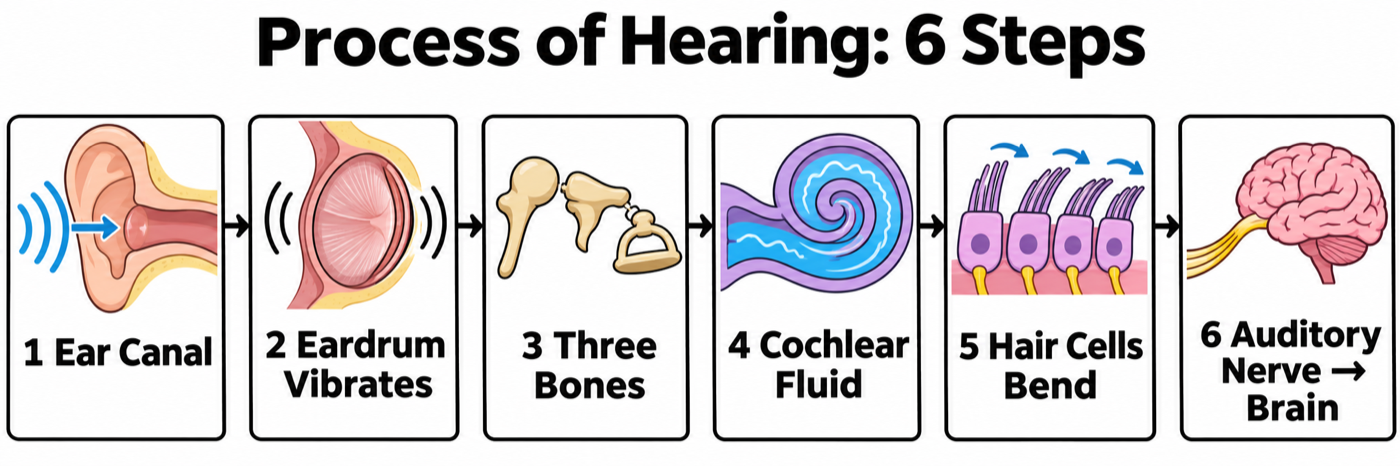
Process of hearing: 6 steps
- Sound is funnelled into the ear canal and moves the eardrum.
- The eardrum vibrates in step with the sound.
- The vibrations pass through the ossicles (three bones) to the cochlea.
- The vibrations make the fluid in the cochlea move.
- The fluid movement makes the hair cells bend; they create nerve signals, which the auditory nerve picks up. Hair cells at one end of the cochlea send low-pitch information, and those at the other end send high-pitch information.
- The auditory nerve sends the signals to the brain, where they are understood as sound.
What actually happens in the cochlea?
- Sound passes from a large area (the eardrum) into a small opening (the oval window, the entrance to the inner ear), so the sound energy is concentrated.
- So the middle ear increases the sound pressure by about 20 times - mainly because the eardrum is much larger than the oval window, helped by the lever action of the ossicles.
- When the stapes presses on the oval window, waves form in the cochlear fluids (first in the perilymph, and through it in the endolymph). The wave travels along the cochlear duct and the basilar membrane up to the round window.
- These waves move the hair cells on the basilar membrane. Sound, which was mechanical energy in the middle ear, changes here into electrical energy / a nerve impulse.
- The hair cells do not produce the impulse themselves; they release a chemical signal to the auditory nerve fibres, and the nerve produces the impulse.
- Only when sound waves have been changed into nerve impulses can the brain perceive the sound meaningfully.
Process of hearing: 5 conduction stages
Sound energy travels through air in the outer ear, through the bones (ossicles) of the middle ear and through fluid in the inner ear, then becomes a nerve impulse and is understood in the brain. That is:
| Stage | Where |
|---|---|
| 1. Air conduction | From the outer ear up to the eardrum |
| 2. Ossicular conduction (through the middle-ear bones) | From the eardrum, along the three bones, up to the inner ear |
| 3. Fluid (water) conduction | Up to the organ of Corti |
| 4. Nerve conduction | Into the brain |
| 5. Interpretation | In the brain |
A block at any of these five stages causes hearing loss.
- Some sounds, especially very loud noises, reach the inner ear directly through the bones of the skull without passing through the eardrum. This is called bone conduction. Sounds heard this way are not as clear as those heard through the eardrum. (This is different from stage 2 above, where sound passes along the three middle-ear bones.)
Units for measuring sound
- Decibel (dB): the unit of the relative intensity / loudness of sound. It shows the amount of energy travelling from the sound source to our ear (or a microphone).
- 0 dB = the point at which a person with normal hearing can detect the faintest sound. Beyond that, the higher the threshold in dB, the greater the hearing loss.
- A drop of more than 10 dB in the level of sound one can hear is significant.
- Hertz (Hz): the unit of the frequency / pitch of sound. Humans can hear sounds of about 20 to 20,000 Hz. Hearing tests mainly check between 250 and 8000 Hz.
- A person with normal hearing can detect sounds of about 10 to 15 dB. If a person cannot hear sounds below 70-80 dB, and experiences even loud sounds as ordinary ones, it is a serious problem.
- An ordinary conversation between two people is at about 45-55 dB; a whisper is much lower and a shout much higher.
Previous papers questions asked in the exam on what you just read
Sound intensity of normal conversation of any two persons are in between these decibels
- (1)35 – 45 dB
- (2)45 – 55 dB
- (3)55 – 65 dB
- (4)65 – 75 dB
Answer & explanation
Correct answer: (2) 45 – 55 dB
The question asks the loudness range of ordinary conversation between two people.
Loudness is measured in decibels (dB). A whisper is roughly 20–30 dB, normal talk is in the middle range, and shouting is above 80 dB. This comparison helps in understanding hearing loss levels: a person whose loss is greater than conversational level cannot hear ordinary speech clearly.
As per the official key, normal conversation lies between 45 and 55 dB, option (2). Different books give slightly different figures for conversation, from about 40 to 60 dB; for this exam remember the key's range.
35–45 dB is closer to soft speech. 55–65 dB and 65–75 dB are closer to loud speech and busy traffic noise. So by the key, options (1), (3) and (4) are wrong.
Remember: Whisper about 30 dB, conversation about 50 dB, shout above 80 dB.
Exam focus: The 6 steps of hearing: ear canal → eardrum → ossicles → cochlear fluid → hair cells → auditory nerve/brain. The 5 conduction stages: air → middle-ear bones (ossicles) → fluid → nerve → brain. The middle ear increases sound pressure about 20 times (large eardrum, small oval window, plus the ossicle lever). Mechanical energy becomes electrical energy in the organ of Corti / hair cells. Intensity = decibel; frequency = hertz. Sound is consciously experienced in the auditory cortex of the temporal lobe.
Memory code: The 5 conduction stages "A-B-F-N-B" - "All Bones Float Near the Brain": Air → Bones of the middle ear → Fluid → Nerve → Brain. The pair of units "D-L, H-P": Decibel = Loudness, Hertz = Pitch.