Like other children, children with autism must also earn a living when they grow up. Vocational training gives them that skill.
Why is employment important?
- Training that leads to a job gives a young person self-esteem, self-confidence, dignity and a sense of achievement.
- The chance to contribute to society as a productive worker increases independence and gives a positive self-image and sense of identity.
- Employment improves cognitive performance, reduces anxiety and depression, and increases relationships with peers.
- Even so, the picture is not hopeful: research shows that recently only 25% of people with ASD were employed. In a study of 169 adults with high-functioning autism, only about half (49%) were in paid employment, and 36% depended on social security benefits.
When and how should vocational training be given?
- Adolescence is the key time to begin vocational training - ideally at around 14 years of age. Yet vocational readiness begins much earlier in life; starting early is the key to success.
- What training to give depends on the child's level of functioning, strengths and interests.
- Many children with autism like repetitive work. They do well in assembling work, the information technology (IT) sector and manufacturing jobs. Even so, many occupations should be explored to find a suitable job.
- There are courses for children with autism such as filing, data entry and packaging.
- Vocational training includes independent living skills, vocational job training and self-care. However severely affected a person is, with the right training everyone can do some kind of work.
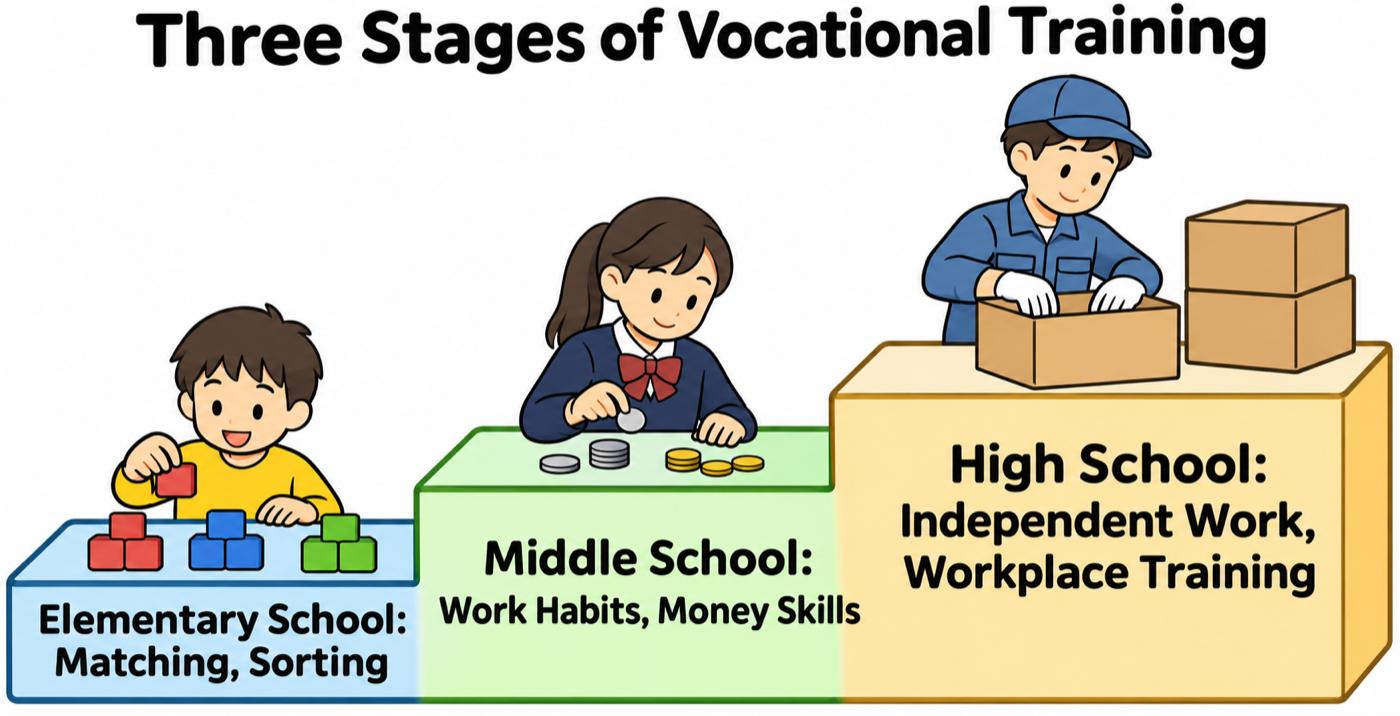
Three stages of vocational training
| Stage | Key skills |
|---|---|
| Elementary school years (pre-vocational readiness) | Tasks that use visual strength: matching, sorting, correcting sorting errors, matching with jigs (picture, drawing and word cues), simple alphabetising, collecting papers, cleaning tables, serving snacks, getting one's own snack, delivering messages, packing, assembling, small purchases |
| Middle school years | Work habits: staying on task, following rules, doing a learnt task consistently; systematic typing, putting papers in order (collating), complex alphabetising, measurement, survival signs, money skills, using vending machines; in the classroom and in community-based settings |
| High school years | Self-protection and safety skills, working without supervision, moving about independently; classroom teaching + training at different workplaces |
Social points to focus on at every stage:
- Starting and responding to interaction with familiar and unfamiliar people
- Understanding prohibitions; understanding and following unwritten rules
- Taking part in positive social experiences
- Keeping proper hygiene and grooming
- Recognising and controlling anxiety and other responses caused by over-stimulation
Care during pre-vocational training
- Give children breaks during daily training. Stay close and give clear instructions when assigning tasks.
- Train them to work independently without anxiety or frustration. Teach them to finish the tasks they are given without complaining or arguing. Teach them to follow instructions that have several steps.
- Teach them to stay calm when the work is briefly interrupted; teach them to accept advice and corrections.
- Teach them to use clocks and phones and to keep to time; make sure social information reaches them; train them to clean their own things.
School-based employment training: 9 steps
| No. | Step | Key point |
|---|---|---|
| 1 | Observing other programmes and collaborating with other agencies | Visiting good classrooms nearby; transition coordinator; groups that share experience (communities of practice); successful programmes: copy centres, mail delivery, recycling |
| 2 | Linking the programme to state education standards | Done sensibly according to the facilities available; for example, a language standard of reading a technical text and solving a problem |
| 3 | Involving students meaningfully in planning | Student interests and preferences; self-determination; student "buy-in" grows and so does motivation; for example, in a restaurant programme, a menu with favourite dishes, prices and decoration |
| 4 | Linking the programme to real-world experiences | Skills that transfer to supported and integrated employment in the community; money handling, job communication (greeting customers, taking orders), hygiene; writing (orders, receipts, menus), reading, maths (bill total, change) |
| 5 | Training materials and pre-vocational tasks that mirror real processes | Treating the training place like a real workplace; employee handbooks; visual supports; food safety test; self-prompting with laminated checklists |
| 6 | Using research-based training methods | Using scientifically proven methods functionally for vocational skills |
| 7 | Including the programme in the school community | Talking with staff outside the special class widens language; visible service gives natural reinforcers; school-wide recognition raises self-esteem |
| 8 | Genuine "real-world" reinforcement | Natural reinforcers such as social praise; a sense of ownership; pay and evaluation systems; a "pay cheque" system, a class shop |
| 9 | Vocational evaluation checklist | Recording the student's strengths and limitations |
- Greater self-determination brings ties with the surrounding community (social capital), more choice and control, better health and financial success.
Vocational evaluation checklist
In the vocational evaluation checklist for a person with autism, each skill is marked "can do" or "can do with help", and comments are written. Areas:
| Area | Skills checked |
|---|---|
| Communication | Understanding speech, asking for what is needed, refusing, conversation, initiative, using pictures/gestures, recognising words, understanding sentences |
| Social skills | Starting interaction, responding, sharing, stopping when needed, taking turns, imitating peers |
| Work behaviours | Working accurately and at a suitable speed; following rules; staying on task; keeping materials in order; finishing work; repetitive tasks and multi-step tasks; solving simple problems; remembering 2-3 step sequences |
| Motor | Strength for work, gross motor, fine motor, visual-motor ability |
| Functional academics | Reading, telling the time, counting |
- Problem-solving skills: what the student does when something is missing, when the work is too hard, when the routine changes, when a favourite person is absent, when he does not know what to do, when he makes a mistake, when something does not work properly, and when he is corrected.
- Motivation: doing work with someone, doing something he likes, doing something of special interest, doing something that uses his strengths, doing it to get something afterwards.
- Performance in tasks (good / fair / poor): assembling, moving things, repetitive cleaning, sequential cleaning, cooking, collating papers, typing, filing, computer work, calculator.
- In the work behaviour checklist each behaviour is coded: learnt skill, emerging skill, not demonstrated. Areas: communication, social skills, socially appropriate behaviour, work speed and output, accuracy and quality.
Employment opportunities: sectors
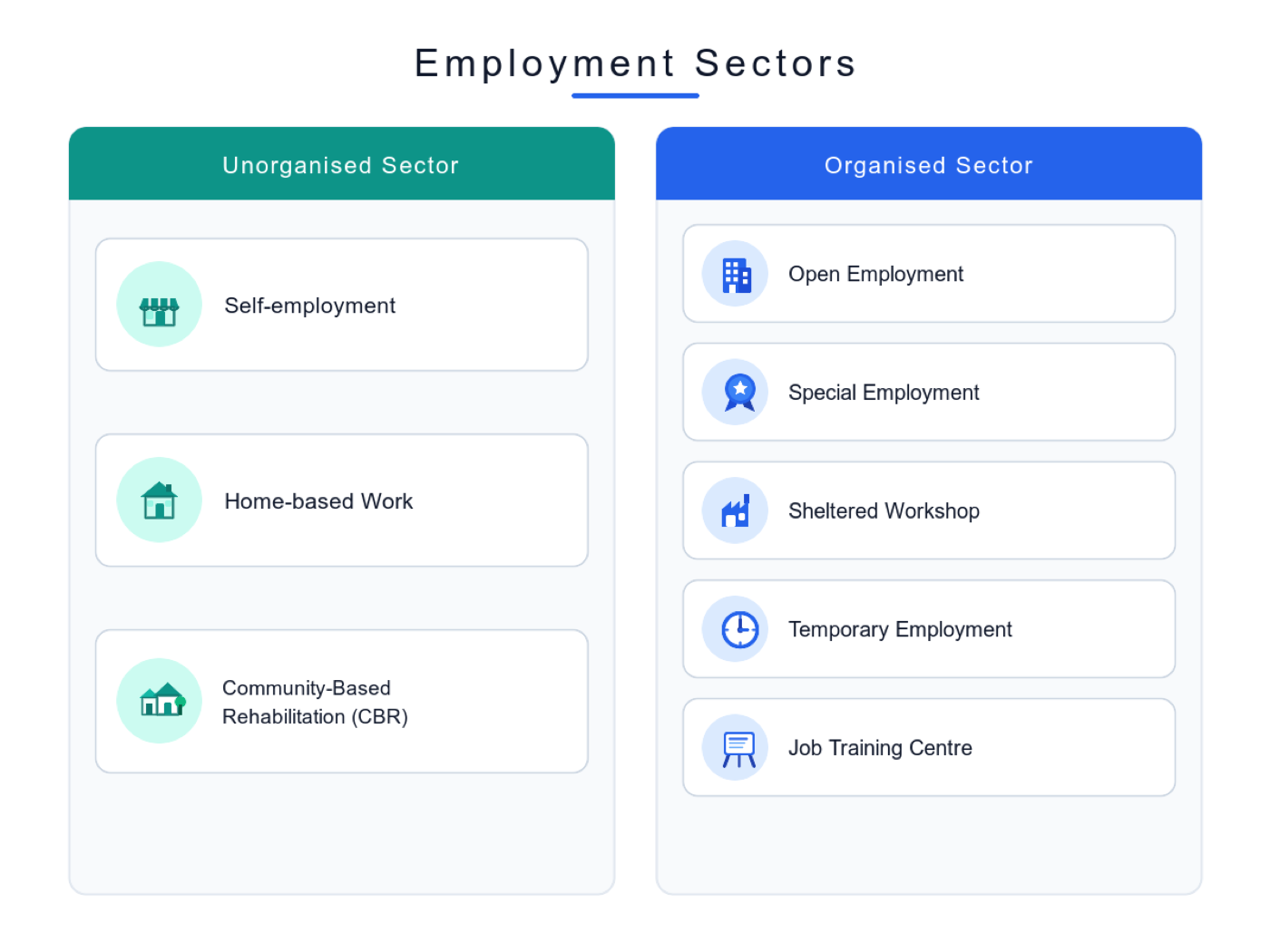
Employment opportunities for people with autism are seen as two sectors. The literature also describes the employment options sheltered employment, supported employment and competitive employment.
| No. | Unorganised sector | Organised sector |
|---|---|---|
| 1 | Self-employment | Open employment |
| 2 | Home-based work | Special employment |
| 3 | Community-Based Rehabilitation (CBR) | Sheltered workshop |
| 4 | - | Temporary employment |
| 5 | - | Job training centre |
Unorganised sector:
- Self-employment: needs schemes, financial help, training facilities, an institutional network, market information, business skills and expert help. Support from the family and community plays a key role. Bank loans, subsidies, low interest and government financial help should be given.
- Home-based work: useful especially in villages, and for women who cannot go out to work because of social restrictions. There should be transport of raw materials and finished goods, training, a sales system, visits by supervisors, family and community support, and fair wages for the work.
- Community-Based Rehabilitation (CBR): low-cost rehabilitation within the community, suited to the person's needs. It brings education, health, empowerment and employment together within the community.
Organised sector:
- Open employment: planned by the central and state governments. Jobs in organisations, corporations, companies, factories, schools, colleges, universities and research institutes. The PWD Act 1995 gave 3% reservation in government jobs (now 4% under the RPwD Act 2016). Trade unions, employers' associations and service clubs together create job opportunities.
- Special employment: work is provided specially in centres set up instead of regular jobs, such as sheltered work centres and job training centres. In this system, vocational training centres give training in a structured, traditional way.
- Sheltered workshop: a work-based rehabilitation facility with a controlled work environment and individual vocational goals, helping the person progress towards regular productive employment. It gives work experience and prepares the person to get a job in the community.
Career planning and problems at work
- When making the job plan, assess the daily living skills of the child with ASD. Build the plan step by step from there. The trainer should create a pleasant atmosphere, encourage the person in every task, and develop skills without letting him get bored.
- Verbal reminders are very useful in employment training. Use technology and mass media. Give pictures and signs according to the schedule. Help from co-workers is essential.
- Routines and a predictable schedule are important. Check the schedule again and again.
- Preparing for a new job: train with strong visual-auditory skills, examples, demonstrations, signs and physical cues. Teach social skills for the interview. For challenges such as managing a project, promotion, office meetings and understanding other people's ideas, a co-worker should help as a mentor or interpreter.
- Possible career options: information management, graphic arts, computer programming, proofreading, quality control, inventory (stock) control, mail services, bookkeeping, banking, accounting, legal research, laboratory work, technical work such as drafting, library services, design and data management.
Exam focus: Ideal age to begin vocational training is around 14 years (adolescence). Three stages: elementary, middle and high school. 9 steps for school-based employment training. Only 25% of adults with ASD employed; study of 169: 49% in paid jobs, 36% on social security. Unorganised sector has 3 types, organised sector 5. PWD Act 1995: 3% reservation.
Memory code: "Start at 14, climb 3 stairs, walk 9 steps" - training at 14 years, 3 stages, 9 steps of school-based employment training. Employment figures "25 - 169 - 49 - 36". Unorganised sector "S-H-C" - Self-employment, Home-based work, Community-Based Rehabilitation.