Transition means moving from one stage, place or activity to another. For children with ASD, change brings fear and stress. So every change must be planned in advance.
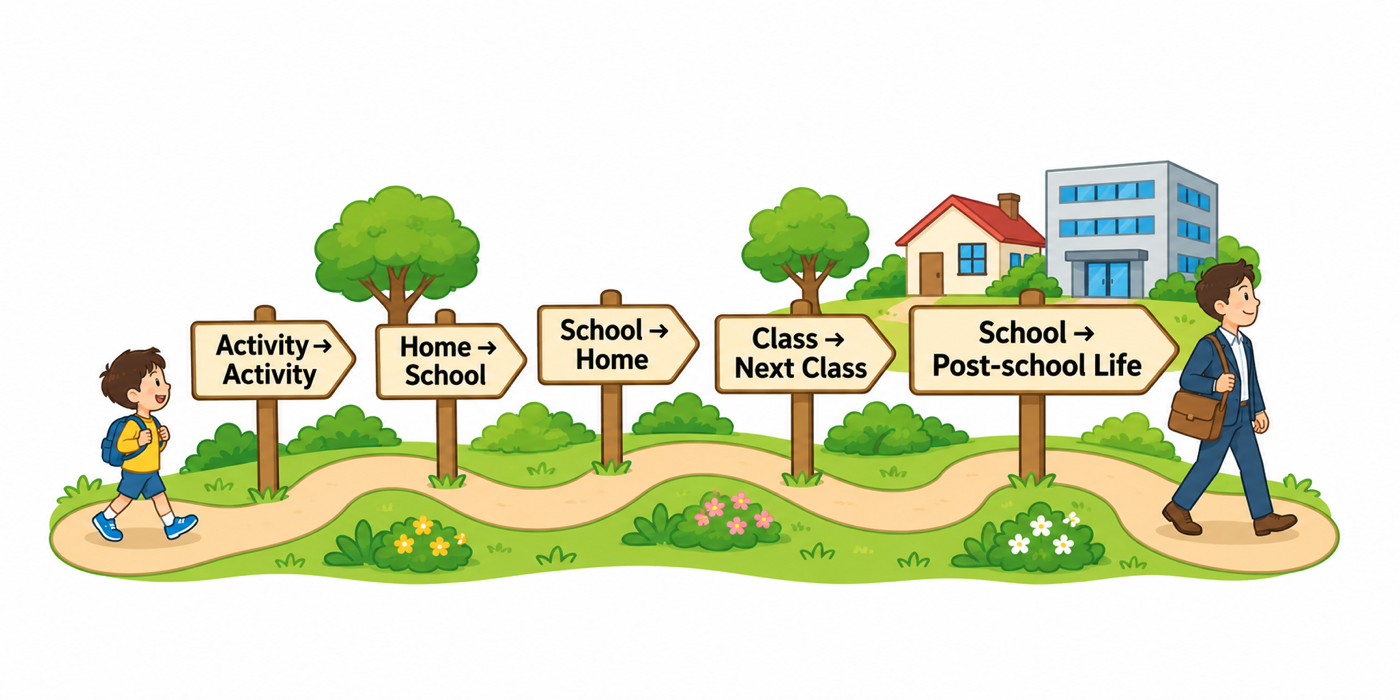
Types of transition (5)
| No. | Transition |
|---|---|
| 1 | From one activity to another activity |
| 2 | From home to school |
| 3 | From school to home |
| 4 | From one class / school to the next class / school |
| 5 | From school to post-school life |
Preparing a transition plan
- Prepare a written transition plan for children with ASD based on their behaviour and needs.
- Plan with the input of family members, professionals and people from the responsible agencies. Only then will the teaching succeed.
- During employment training, consider the development of work quality, work quantity and social skills along with job skills.
- Adapt the educational plan to suit life goals and career goals, and train accordingly. Include employment programmes within the educational plan itself.
- The transition plan should cover education at the present level, employment, living arrangements, recreation, leisure, physical activities and nutrition.
- Other areas needing training: health care needs, transport, social skills, communication, sex education, spiritual matters, financial planning, protection and legal matters.
- A transition coordinator in the school looks after transition needs. The coordinator builds cooperation between agencies, gives technical help, assesses needs and shares information with everyone concerned.
Education after school and laws
- In the USA, the IDEA law ensures that special education services reach young people with disabilities, including autism. The IEP helps them reach goals in line with their interests; they may also choose employment.
- Thomas (2000) noted that after the Rehabilitation Act of 1973 and the Americans with Disabilities Act of 1990 in the USA, institutions became ready to provide post-secondary education services to students with ASD.
- In India, under the RPwD Act 2016, government and government-aided institutions of higher education must reserve at least 5% of seats, and government jobs at least 4% of vacancies, for persons with benchmark disabilities. Of this 4%, 1% is for persons with autism, intellectual disability, specific learning disability, mental illness and multiple disabilities.
Living arrangements and health care
- Living arrangements: elders at home should make arrangements in the family to suit the child's particular lifestyle and needs, and support him in every matter. Not only family members but also neighbours should cooperate.
- Behavioural and medical health care: suitable health care should be given for medical or psychiatric symptoms. Professionals interview parents and caregivers and, based on observation, report on health status and behaviour.
Generalisation: the most important part of transition
- Young people with ASD find it hard to generalise a newly learnt skill to other places, situations, people and settings. So in any employment skills programme, planning for the skill to transfer across places, people, situations and time is key.
- The aim of training is behaviour change. If there is no positive change in most areas of life, the change is not meaningful.
- Generalisation methods suggested by Bellini and colleagues (2010):
- training with many people and in many places
- making sure natural reinforcers follow when social skills are used
- practising the skill in the natural setting
- fading prompts as quickly as possible
- giving many examples of social rules and concepts
- teaching self-monitoring strategies
Exam focus: 5 transitions: activity-activity, home-school, school-home, class-class, school-post-school life. The transition plan is written, with input from the family, professionals and agencies. RPwD Act 2016: 4% in jobs, 5% in higher education. Generalisation methods - Bellini (2010).
Memory code: Transition path "A-H-S-C-P" ("A Happy School Creates Progress") - Activity to activity, Home to school, School to home, Class to class, Post-school life. RPwD "4 for work, 5 for study".