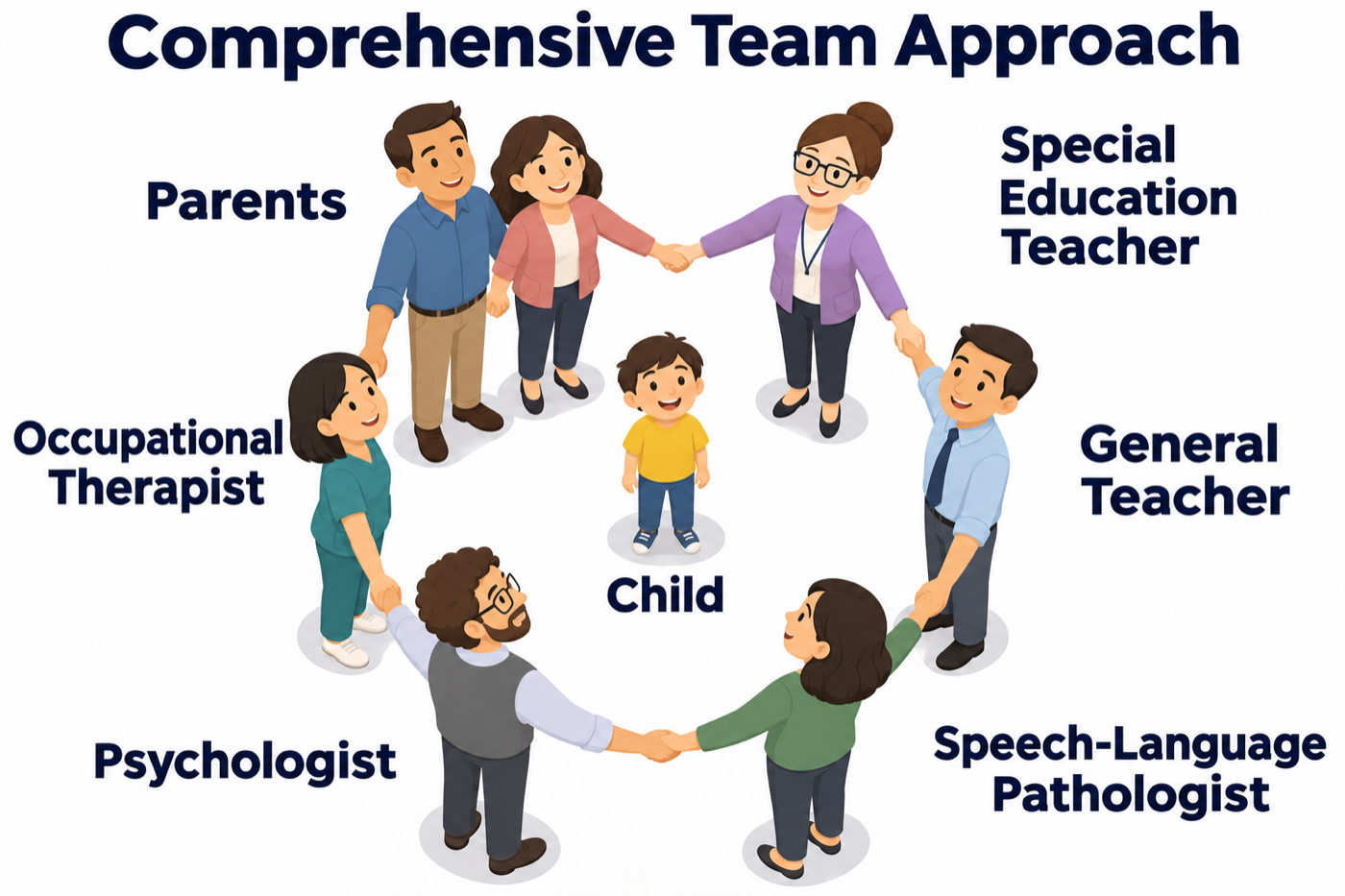
Comprehensive team approach including the family
ASD involves deficits in communication, behaviour and social skills. So an effective programme needs the skills and views of family members and professionals from many fields.
| Team members | Role |
|---|---|
| Parents | Active members in decisions, training and follow-up |
| Speech-language pathologist, psychologist, occupational therapist (related services staff) | Social, behaviour, language and motor skills according to the assessment results |
| Special education teachers, general education teachers, para-educators | Progress towards individual educational goals |
- When everyone works together, there is consistency in teaching methods across people, lessons and settings. This makes it easier to learn, keep and generalise new skills.
- Features of the team approach:
- Goals are generalised consistently across the whole educational programme.
- With suitable support in the classroom, the student can show progress on his goals.
- Professionals and parents together decide how often and in what form they will communicate.
- Problems are discussed as soon as they arise, before they get out of hand. Teachers involve parents in solving problems.
- Parents are not afraid to ask about any part of their child's programme.
- Parents and teachers should work together for the language development of children with ASD. Example: parents can use the moment when the child asks for dishes to eat as a chance to teach conversation.
- Teachers, parents and peers should together develop the communication system of children with ASD. Train family members so that they join in the teaching.
Tips for parents of a child with a disability
- Take help from other parents.
- Rely on the positive resources in your life (counsellors, special educator, speech therapist, occupational therapist).
- Take one day at a time.
- Learn the related terms; look for information (internet, support groups, library).
- Do not be afraid; keep a positive outlook.
- Look for programmes that suit your child.
- Take care of yourself too; decide how you will deal with others.
- Keep daily routines as normal as possible.
- Know that you are not alone.
- Most important of all: do not lose your sense of humour.
Parents of children with autism go through a lot of stress. Children should be given chances to be happy; a job in adulthood brings them happiness.
Opportunities with peers
- Give structured activities with one peer or in small groups to practise newly learnt social, academic, communication, coping and self-help skills.
- Chances to mix with peers of different abilities help generalisation.
- Give support and opportunities to build friendships.
- Give peers a comfortable time and atmosphere to ask questions about ASD and get age-appropriate information.
- Encourage parents to meet the staff and share information about their child.
- Videos, books and leaflets on ASD should be available to staff, students and families.
- Support staff who are learning to include the student in activities.
- Children share with friends what they cannot tell even their parents and teachers. That is why the help of the peer group is so necessary.
Role of the community and government support
- Not only family members but also neighbours and the community should support the person with ASD.
- In Community-Based Rehabilitation (CBR), education, health, empowerment and employment come together within the community itself. Its aim is the full participation and empowerment of persons with disabilities.
- Trade unions, employers' associations and local service clubs create job opportunities.
- The National Trust Act 1999 runs schemes for persons with autism, cerebral palsy, intellectual disability and multiple disabilities:
| Scheme | What it provides |
|---|---|
| Disha | Early intervention and school readiness for children under 10 years |
| Vikaas | Day care for those above 10 years |
| Samarth | Respite care - residential facility |
| Gharaunda | Lifelong housing and care services for adults (group home) |
| Niramaya | Health insurance |
| Sahyogi | Caregiver training |
Exam focus: In the comprehensive team, parents are active members, along with the speech-language pathologist, psychologist, occupational therapist and teachers. The most important tip for parents: do not lose your sense of humour. National Trust schemes: Disha (under 10, early intervention), Vikaas (day care), Samarth (respite), Gharaunda (group home), Niramaya (health insurance), Sahyogi (caregiver training).
Memory code: National Trust schemes in order of life "D-V-S-G-N-S" - Disha = early Direction (early intervention, under 10), Vikaas = day care (above 10), Samarth = reSpite care, Gharaunda = Group home, Niramaya = health iNsurance, Sahyogi = Support for caregivers (caregiver training).