ABA stands for Applied Behaviour Analysis. It rests on Skinner's operant conditioning. Its core idea is that positive reinforcement increases good behaviour.
Why does ABA suit ASD?
- It contains highly structured, systematic teaching strategies and data-based evaluation.
- ABA intervention involves:
- understanding strengths and deficits in skills and behaviour
- structuring the learning environment
- breaking a skill into small, observable steps and teaching them in order
- teaching the child to keep a learnt skill (maintenance) and use it in other places (generalisation)
- It is direct, systematic teaching based on learning principles drawn from laboratory research. It includes differential reinforcement, task analysis and continuous monitoring of performance.
- Aim: to increase or decrease a behaviour. Examples: reducing hitting others, increasing the ability to follow a visual schedule, increasing the length of eye contact.
- It can be used anywhere: school, home or playground. It builds skills such as eye contact, listening, imitation, reading, conversation and understanding other people's minds.
- It can be used in both structured settings (classroom) and everyday settings (family), one-to-one or in groups.
- Intensive early intervention programmes usually use ABA with children under 4 years.
Two stages of ABA
| Stage | What is done |
|---|---|
| 1. Assessment | The behaviour analyst assesses the child's abilities, disabilities, likes and dislikes in different areas |
| 2. Intervention | The skill to be taught is broken into small parts and taught from easy to hard; progress is then measured and, if needed, the child is reassessed |
Strategies used in ABA
The main strategies are prompting, shaping, fading, chaining and modelling. Reinforcement, time out and extinction are also used. Differential reinforcement and punishment are two important methods for managing problem behaviour.
Prompting (giving a cue or support)
A prompt is the extra help given to the student so that the correct response comes. Types of prompts:
| Type of prompt | Example |
|---|---|
| Verbal | Saying "Wash your hands" |
| Modelling / demonstration | The teacher does it and shows |
| Visual | Showing a picture or a drawing |
| Positional | Placing the correct item closer to the child |
| Physical | Holding the child's hand and guiding the action |
| Gestural | Pointing with a finger, nodding |
| Expectant waiting | Looking at the child expectantly and waiting for the response |
- A prompt can be given together with the instruction, during the response to reduce errors, or after a wrong response to show the correct answer.
Previous papers questions asked in the exam on what you just read
"Pointing the student's knees to remind student's needs to straighten them" in yoga class is called
- (1)Verbal Prompt
- (2)Gestural Prompt
- (3)Physical Prompt
- (4)Modelling Prompt
Answer & explanation
Correct answer: (2) Gestural Prompt
In a yoga class, the teacher does not speak or touch; the teacher only points at the student's knees to remind the student to straighten them. The question asks what type of prompt this is.
A prompt is extra help given by the teacher so that the child gives the correct response. A verbal prompt uses words. A gestural prompt uses pointing, nodding or hand signs. A physical prompt means the teacher physically guides the child's body. A modelling prompt means the teacher demonstrates the action.
Here the teacher only points, which is a gesture, so the answer is option (2) Gestural Prompt. It is not verbal (1) because nothing is said, not physical (3) because the knees are not touched or moved, and not modelling (4) because the teacher does not do the pose to show it.
Remember: Pointing or signing = gestural prompt.
Fading (reducing help step by step)
- Gradually reducing the help (prompt) as the child improves is called fading. It lays the base for the next step.
- Prompts should be faded as quickly as possible; otherwise the child comes to depend on the help.
Previous papers questions asked in the exam on what you just read
Helping a student in completing his task and gradually minimising it depending on his improvement is
- (1)Fading
- (2)Prompting
- (3)Chaining
- (4)Imitation
Answer & explanation
Correct answer: (1) Fading
The question asks for the behavioural teaching technique in which help is first given and then gradually reduced as the student improves. It belongs to behaviour modification techniques.
Fading means withdrawing the help or prompt step by step, until the student can do the task with no help at all. For example, first guiding the child's hand to write their name, then letting them trace over dots, and finally letting them write alone. The key words in the question are 'gradually minimising' the help. So the answer is option (1), fading.
Prompting (2) is only giving the help or cue; reducing it is fading. Many students choose (2), but the question is about the reducing. Chaining (3) is breaking a big task into small steps and teaching them in sequence. Imitation (4) is learning by copying others.
Remember: Prompt = give help; fade = reduce help.
Shaping (reinforcing successive approximations)
- First any response close to the desired behaviour is reinforced, and then every small step towards the goal is reinforced. These steps are called successive approximations.
- Shaping is most useful when the student does not have the desired skill at all.
- Guidelines: a clear goal; observation in the natural setting to find the starting point; clear steps that are neither too big nor too small; fading prompts for the next step.
- Example (sitting in a group):
| Step | Behaviour reinforced |
|---|---|
| Step 1 | Reinforce standing near the group |
| Step 2 | Reinforce standing very close to the group |
| Step 3 | Reinforce standing in the middle of the group |
| Step 4 | Reinforce sitting in the group |
Chaining
The steps of a task are taught in order, like the links of a chain.
- Forward chaining: the first link (step) is taught and the child is guided through the remaining steps. Example: when teaching a child to write his name, first teach the first letter. It is used to teach a new motor skill such as throwing a ball step by step.
- Backward chaining: start from the last link and work backwards. The teacher does all the earlier steps and has the child do the last step. The child gets the joy of finishing the task straight away. Putting on socks, taking off a shirt, and putting on shoes and tying the laces are taught this way.
Modelling
- Showing an action or a sequence of actions, with or without words. It may be a live demonstration, done through pictures, or shown by several people together.
Task analysis
- Decide which skill to teach
- Break the skill into small parts
- Decide whether the parts come one after another (sequential) or happen at the same time (simultaneous)
- Plan how to teach it
Previous papers questions asked in the exam on what you just read
The methods followed in developing task analysis. i) Self-Monitoring ii) Evaluation iii) Brainstorm iv) Backward chaining v) Feedback
- (1)i, ii, iii, iv, v
- (2)i, ii, iii, iv
- (3)i, iii, iv
- (4)iii, iv, v
Answer & explanation
Correct answer: (3) i, iii, iv
The question asks which methods are used to develop (write) a task analysis.
Task analysis means breaking a skill, such as wearing a shirt, into small steps in the right order. It is a key strategy for teaching children with intellectual disability. To find the steps, the teacher can do the task himself and note each movement (self-monitoring), sit with others and list every step the task needs (brainstorming), and start from the final step and work back to the first one (backward chaining).
So i, iii and iv are methods of developing a task analysis, and the answer is option (3).
Evaluation (ii) and feedback (v) come after the task analysis has been written and used in teaching; they are not ways of building the steps. So options (1), (2) and (4), which include them, are wrong.
Remember: Building a task analysis: do it yourself, brainstorm, chain backward.
Memory code: ABA strategies "Please Stop For Chocolate Milk" - Prompting, Shaping, Fading, Chaining, Modelling. Prompt = Put help in, Fading = Fade help out; Backward chaining = Begins at the end (last step first).
Reinforcement and punishment (feedback)
| Type | Effect |
|---|---|
| Positive reinforcement | Increases the chance of the behaviour happening again |
| Negative reinforcement | Increases the chance of the behaviour happening again |
| Punishment | Decreases the chance of the behaviour happening again |
Types of reinforcers:
| Type | Examples |
|---|---|
| Primary reinforcers | Food, sensory pleasure, satisfying a compulsive drive |
| Secondary reinforcers | Praise, social routines, intense interests, the need to finish a task (closure) |
- Praise, a smile and appreciation are also called social reinforcers.
Previous papers questions asked in the exam on what you just read
Food, water, sleep etc… are this type of reinforcements.
- (1)Primary
- (2)Secondary
- (3)Social
- (4)Emotional
Answer & explanation
Correct answer: (1) Primary
The question asks what kind of reinforcers food, water and sleep are.
Primary reinforcers satisfy basic biological needs and work without any learning: hunger, thirst and sleep are natural needs, so food, water and rest are rewarding from birth. Secondary (conditioned) reinforcers such as money, marks, tokens or stickers get their value only after they are linked with primary ones.
Food, water and sleep meet biological needs, so they are primary reinforcers. The answer is option (1).
Secondary reinforcers are learned. Social reinforcers are praise, a smile or a pat on the back. 'Emotional' is not a standard type of reinforcer here. So options (2), (3) and (4) are wrong.
Remember: Needs of the body = primary; learned value = secondary.
Praise, smile, appreciation are this type of reinforcement
- (1)Primary
- (2)Social
- (3)Secondary
- (4)Emotional
Answer & explanation
Correct answer: (2) Social
The question asks which type of reinforcement praise, a smile and appreciation belong to. This is a key idea in behaviour modification, especially when teaching children with intellectual disability.
A reward given right after a desired behaviour makes that behaviour more likely to happen again. Rewards that come from other people, such as praise, a smile, clapping or a pat on the back, are called social reinforcers. They cost nothing and can be given at any time. So the answer is option (2) Social.
Primary reinforcers, option (1), satisfy natural needs, like food and water. Secondary reinforcers, option (3), are things like tokens, stickers and money, which have only a learned value. Emotional, option (4), is not a standard category of reinforcers. In general psychology social reinforcers are sometimes grouped under secondary ones, but among these options the exact name is social.
Remember: Food = primary, token = secondary, praise = social.
- Differential reinforcement: ignore the inappropriate behaviour and reinforce the correct behaviour that takes its place. Its types are DRO (Differential Reinforcement of Other behaviour - reinforcing the child when he does not show the inappropriate behaviour) and DRA (Differential Reinforcement of Alternative behaviour - reinforcing a correct behaviour done instead of the inappropriate one).
- If the reinforced behaviour and the inappropriate behaviour cannot be done together, the child cannot show the inappropriate behaviour while he is doing the correct one.
Discrete Trial Training (DTT)
- ABA is a broad approach; DTT is a specific teaching method used under it.
- It is a structured strategy that breaks a task into the simplest teachable parts and teaches them in a planned, controlled order.
- Features: discriminative stimuli and task analysis; each trial has a clear beginning and end; every trial is the same; teaching is repeated; cues are exaggerated, so that they are very clear and easy to notice.
- Data collection is a key part of DTT. The starting skill level, progress, problems, mastery and generalisation are all recorded.
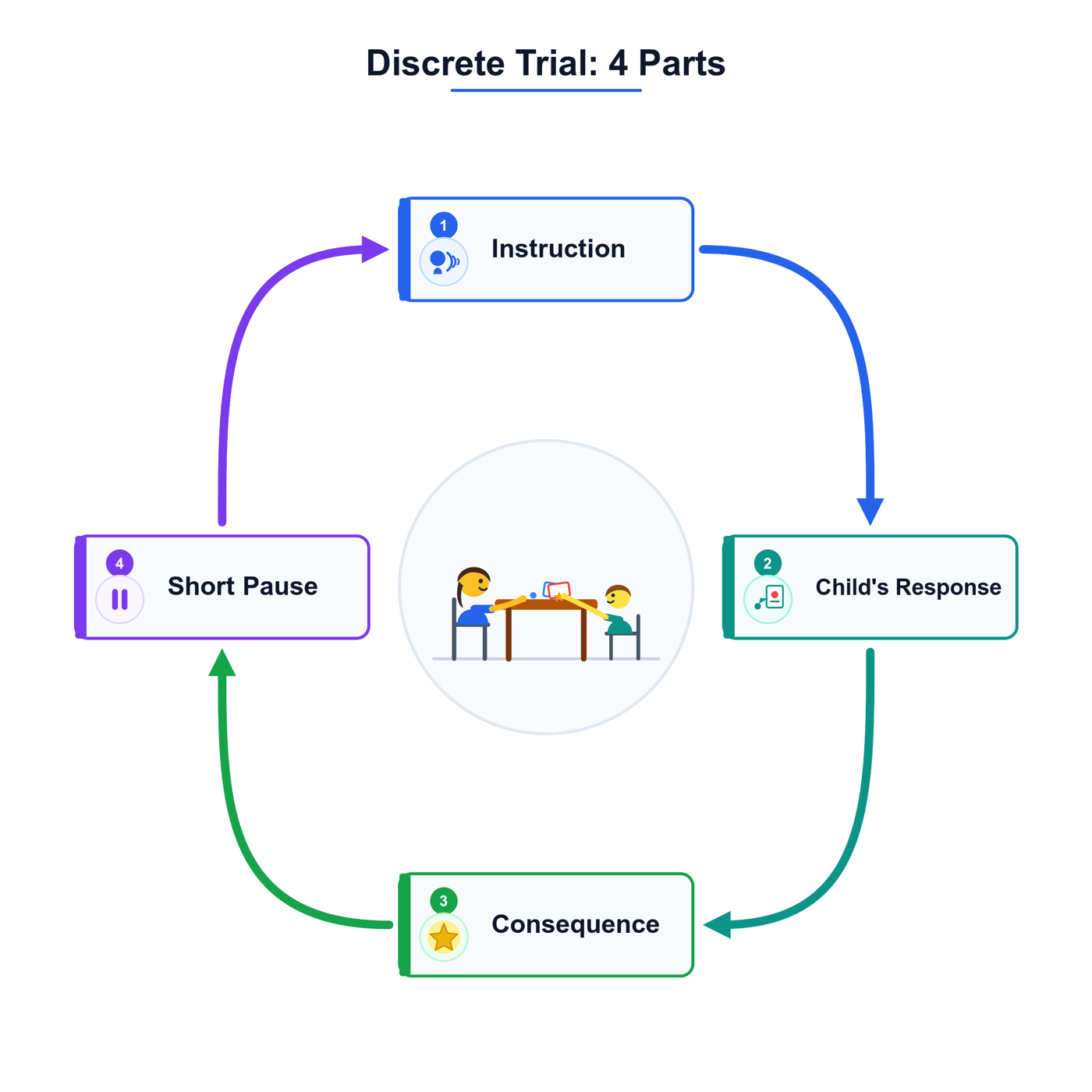
The 4 parts of each trial:
| No. | Part |
|---|---|
| 1 | Instruction |
| 2 | Child's response |
| 3 | Consequence - reinforcement or correction |
| 4 | Short pause |
Previous papers questions asked in the exam on what you just read
Components of the teaching strategy discrete trail are
- (1)Activity, Reinforcement, Antecedent, Response
- (2)Appearance, Activity, Punishment, Reaction
- (3)Structure, Support, Motivation, Reinforcement
- (4)Instruction, Childs Response, Consequence, brief pause
Answer & explanation
Correct answer: (4) Instruction, Childs Response, Consequence, brief pause
The question asks for the parts of one trial in Discrete Trial Training (DTT), a method widely used with children with autism.
DTT is based on Applied Behaviour Analysis (ABA). A skill is broken into small parts and each part is taught through short, repeated 'trials'. Every trial follows the same order: the teacher gives a clear instruction, the child responds, the teacher gives a consequence (reinforcement for a correct response, correction for a wrong one), and then there is a brief pause (inter-trial interval) before the next trial. A prompt may be added after the instruction when needed. So the answer is option (4).
Option (1) mixes ABC terms with 'activity', which is not a part of a trial, and it misses the pause. Option (2) includes 'punishment' and 'appearance', which are not DTT components. Option (3) lists general teaching principles, not the sequence of a trial.
Remember: One discrete trial = instruction → response → consequence → pause.
Pivotal Response Training (PRT)
- It uses the DTT model, but lessons are child-directed. It encourages teachers to plan the lesson inside activities the student likes.
- It relies on natural learning opportunities and the child's own interests.
- It works on development, communication, language, pretend play and social behaviour.
- It strengthens four pivotal learning areas: motivation, responding to multiple cues at once, social initiation and self-management.
Functional Communication Training (FCT)
- First, find out what the child is trying to say through the problem behaviour (its communicative purpose).
- Then teach a correct alternative behaviour (a word, a picture or a sign) that meets the same need. Before this, the function of the behaviour can be found with an FBA.
Aims of ABA at a glance
| Purpose of ABA | Example | How it is done |
|---|---|---|
| Increasing positive behaviour | Increasing a desired behaviour | Set a goal and give a reinforcer the student likes when it is reached |
| Teaching a new skill | Throwing a ball (a motor behaviour) | Forward chaining, step by step |
| Generalisation / transfer | Keeping the student's attention | Transferring a self-management method that worked in class to other places; collecting data |
| Limiting inappropriate behaviour | Shouting inappropriate words | Teaching the use of suitable language in its place |
- To use ABA well, parents, educators and other professionals should decide goals and strategies together. How intensively it is used differs from child to child.
Exam focus: ABA = Skinner's operant conditioning; 2 stages (assessment, intervention). 4 parts of a DTT trial: instruction, child's response, consequence, short pause. Fading = gradually reducing help. Shaping = reinforcing successive approximations. Food = primary reinforcer; praise = secondary / social reinforcer. Punishment decreases behaviour; both kinds of reinforcement increase it. PRT = child-directed DTT.
Memory code: DTT trial "I-R-C-P" - Instruction, Response, Consequence, Pause ("I Respond, Coach Pauses"). PRT pivotal areas "2 M + 2 S" - Motivation, Multiple cues, Social initiation, Self-management.