Developmental approach
- A good starting point is to see children with ASD, just as we see other children, in terms of their developmental level.
- For young children, methods suited to age and development matter most. For older students, functional skills (skills useful in daily life) become the main focus.
- The developmental sequence differs between skill areas and even within one area. Some areas are well developed while others lag behind.
- Some children perform higher-level skills beyond their age but cannot reliably perform the basic lower-level skills. These gaps must be identified.
- This approach works like a "blueprint": based on the child's strengths and weaknesses, we can choose step by step which skill to teach after which.
- It is especially suited to teaching social relationships and emotional behaviour. Its aim may be to set the developmental sequence of social and emotional skills.
Floor Time (DIR model)
- The best known of the developmental, relationship-based approaches is Floor Time. It was developed by Stanley Greenspan and Serena Wieder.
- The adult sits on the floor with the child, follows the child's interest while playing, and builds up back-and-forth interaction. That is why Floor Time is described as a play therapy.
Previous papers questions asked in the exam on what you just read
A classroom strategy 'Floor time' means
- (1)Water Therapy
- (2)Play Therapy
- (3)Drug Therapy
- (4)Mud Therapy
Answer & explanation
Correct answer: (2) Play Therapy
The question asks what kind of therapy the strategy called Floor Time is.
Floor Time was developed by Stanley Greenspan for children with Autism and related developmental disorders. The adult literally gets down on the floor with the child, joins the child's chosen play and follows the child's lead, using the play to build attention, two-way communication and emotional connection. It is therefore a form of play-based therapy, so the answer is option (2) Play Therapy.
Water therapy (1) uses exercises in water. Drug therapy (3) means medicines prescribed by a doctor. Mud therapy (4) belongs to naturopathy. None of these involves playing with the child on the floor.
Remember: Floor Time: get on the floor and play.
Play
- Play has long been used in interventions for children with psychological and medical problems. It is an effective tool for teaching children with ASD.
- The TEACCH programme recognised that children with ASD find it very hard to learn ordinary play behaviour on their own or by watching others. So play must be taught in a structured way. For children with ASD, "play is work, and work is play".
- Play can teach the proper use of toys and leisure items.
- Tolerance grows step by step: first for playing alongside others, then for playing cooperatively with them.
- Play can be done in one-to-one teaching and in small play groups. Play training supports social, language and cognitive development in a relaxed, natural setting without fear.
- Play goals and play groups should be based on each child's level of functioning and special needs. Group activities must have clear goals.
- Note: Traditional play therapy based on psychoanalysis (used to teach a child coping strategies) does not work for children with autism.
Psychotherapies
- Mental health professionals in schools, the community and medical settings should support families, especially families whose child has just been diagnosed with ASD.
- They advise teachers, run social skills groups for children, and train school staff and community workers.
- It is well established that individual "talk therapy" is of little use to children with ASD. But therapy strategies aimed at behaviour change and skill building are useful.
Sensory-motor therapies
- Sensory integration theory has given valuable information about how people with ASD take in and respond to sensations from outside.
- Sensory integration difficulties have a strong effect on behaviour. Activities that correct too little or too much sensory input help independent functioning.
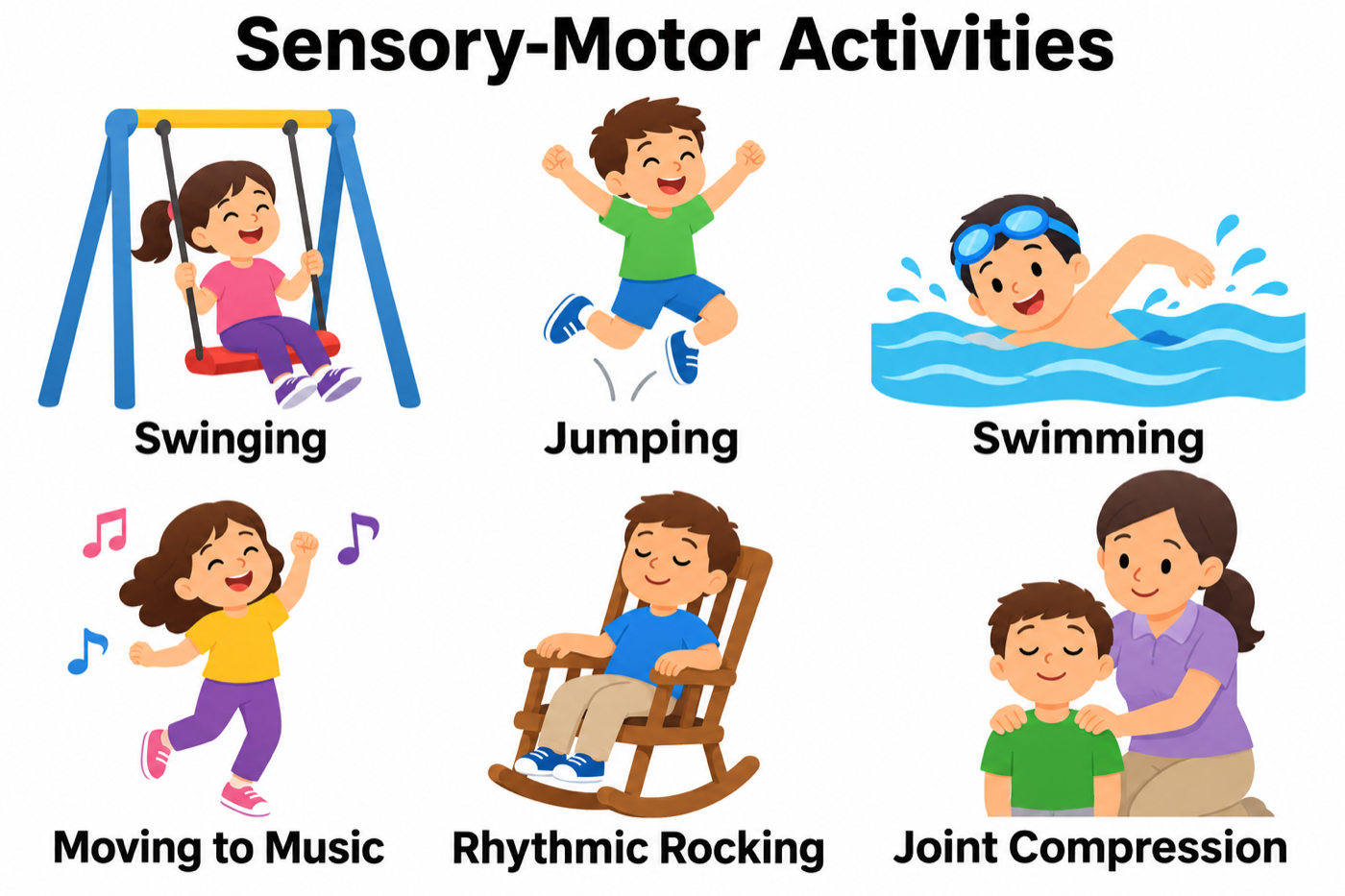
- Alerting and calming activities: rhythmic rocking, gradual pressure on the body, joint compression, swinging, jumping, moving to music and swimming. These increase attention to the task and calm the child.
Diet therapy
- Experts advise that giving the right food at the right time can improve the health of children with autism. It is one of the alternative therapies.
- Some children are said to develop an allergy to the gluten in wheat and barley and the casein in milk and milk products. So a gluten-free, casein-free diet is suggested.
- If any change or problem is noticed, specialists carry out allergy tests. Make sure the child still gets enough protein.
- Following a specific diet is thought to reduce some symptoms and improve social and cognitive behaviour.
Exam focus: Developmental approach = "blueprint"; best suited to social and emotional teaching. Floor Time = play therapy (Greenspan). For children with ASD "play is work, and work is play" (TEACCH). Psychoanalytic play therapy and individual talk therapy do not work. Diet therapy = gluten-free, casein-free diet.
Memory code: "Floor = Fun" - Floor Time = sitting on the floor for play therapy. Keep out "G-C" - Gluten (wheat, barley: Grains) and Casein (milk: Cow).