Every child with autism is different, so one programme cannot suit everyone. Whatever programme is chosen, a few basic principles must be followed.
Principles a good teaching programme must follow
- Choose the most effective programme that gives results. It should rest on current research and proven good practice.
- It must be carried out by trained, competent staff, with parents taking part where needed. Staff should have specialised training, a certificate or a licence.
- The child's strengths and needs should drive the curriculum. There should be flexibility to combine methods that suit the child's different needs.
- Combine several methods and approaches. Choose strategies that give the most benefit at the least cost.
- The programme should be based on the results of a comprehensive assessment. It should address the features of ASD and be useful in the community (social validity).
- The programme should be decided by a multidisciplinary IEP team that includes the parents. Different professionals in different settings should carry it out in the same, coordinated way.
- The programme should be outcome-based: measure how much it actually helps the child. Each child's programme must be individualised.
- Ongoing assessment: check results regularly with performance-based assessment and observation data. Fix in advance the criteria for saying a goal has been "learnt".
Six main teaching approaches
The comprehensive programmes used for young children with ASD are described as six main approaches:
| No. | Approach | Main idea |
|---|---|---|
| 1 | Developmental approach | Teach according to the child's level and sequence of development |
| 2 | Applied Behaviour Analysis (ABA) | Break behaviour into small steps and teach it with reinforcement |
| 3 | Structured teaching | Make the environment orderly and predictable |
| 4 | Psychotherapies | Family support, behaviour change, skill building |
| 5 | Sensory-motor therapies | Activities that correct sensory problems |
| 6 | Play | Social, language and cognitive development through play |
A programme is chosen after looking at three things about the child: the child's developmental level, how he learns, his strengths and needs, and which skills he has already learnt. Although they carry different names, most programmes work on similar principles.
- Teaching must start early. Researchers and experts agree that intervention should usually begin before the age of 30 months.
- No single method suits every child. The teacher should first assess the problem area and then choose the method that fits it.
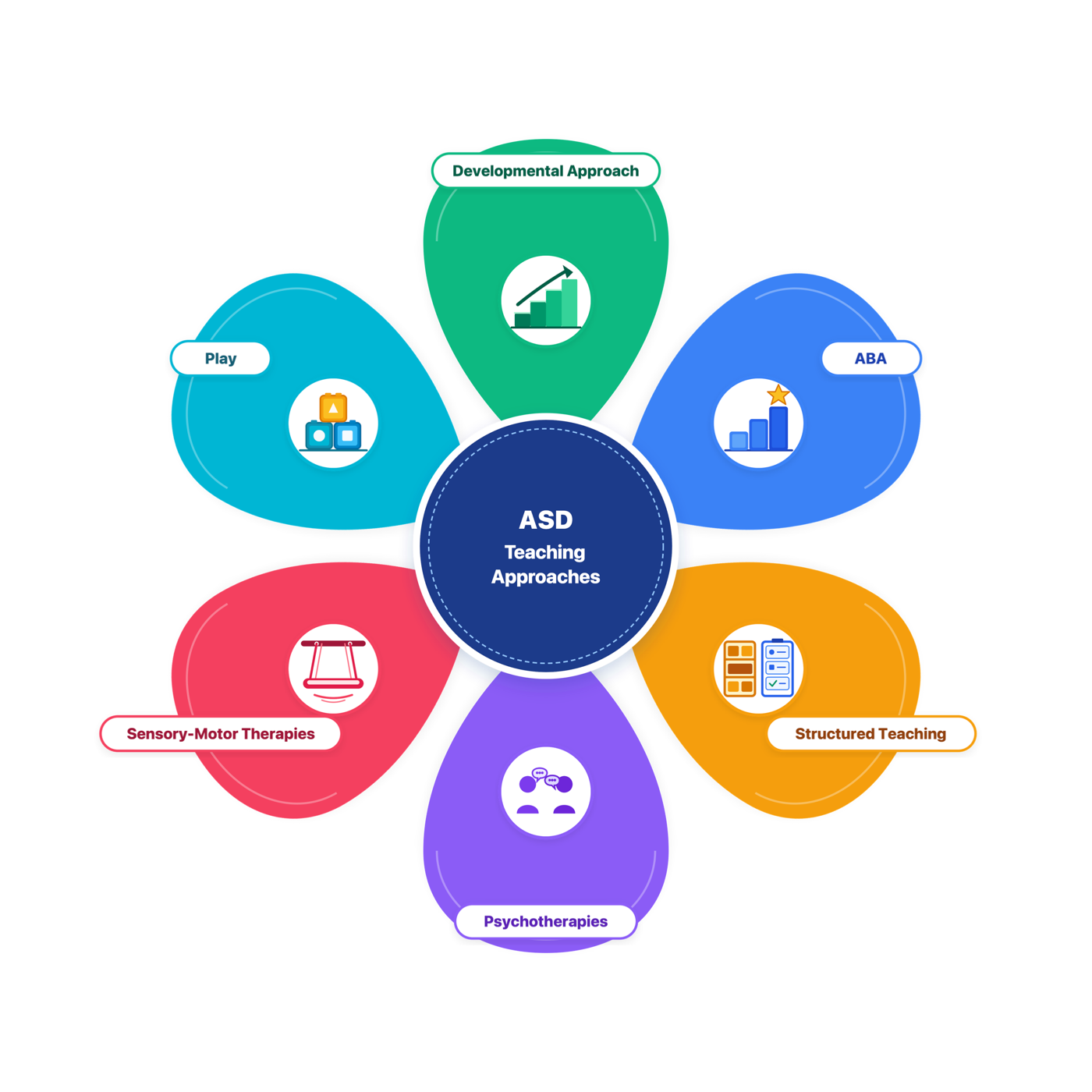
Exam focus: The six approaches: developmental, ABA, structured teaching, psychotherapies, sensory-motor therapies, play. The programme is decided by a multidisciplinary IEP team that includes the parents. Intervention should start before 30 months.
Memory code: "Do A Simple Puzzle, Start Playing" - Developmental, ABA, Structured teaching, Psychotherapies, Sensory-motor therapies, Play. Six words, six approaches.