Laboratory tests: decided by the history
Which laboratory test to do is decided by the clinical history, physical examination and family history. Not every test is for every child.
| Sign seen | Test done |
|---|---|
| Eating things that are not food (pica) | Lead screening |
| Growth deficiency / failure to thrive | Thyroid function test |
| Cyclic vomiting, protein intolerance | Metabolic screening, amino acid chromatography |
| Developmental regression (if the family history / neurological examination suggests it) | Further tests after careful thought |
Genetic testing and genetic counselling
- According to the expert guideline panel, routine laboratory tests should include at least: a high-resolution karyotype and a Fragile X probe (DNA probe for the FMR1 gene).
- These show major chromosomal disorders, but non-chromosomal genetic disorders cannot be ruled out. So the doctor must decide whether a geneticist's advice is needed, and whether more tests are needed to find the cause of intellectual disability if it is present.
- If research proves their usefulness, tests such as FISH for abnormalities of chromosome 15 (q region) are decided by an experienced doctor.
- Check whether the features resemble Rett's disorder; a specific genetic test (MECP2) is now available for it.
- In a few cases, other chromosomal abnormalities (including the q region of chromosome 7) are also linked with ASD; the benefits of further tests should be weighed and discussed with the family.
- Genetic testing matters a great deal: in a family with one child with ASD, the risk of ASD in another child rises. The overall risk is about 6%; if a known genetic cause is found, this may be much higher (or lower). That cause also affects the risk for other family members.
Neurological laboratory tests
These are not routine tests; they are considered according to each child's need.
| Test | When |
|---|---|
| EEG | History of seizures; confirmed regression in language or behaviour (more than is usually seen in ASD); clinical neurological abnormalities |
| MRI or CAT scan (of the head) | Clinical neurological abnormalities: small head, neurological asymmetries (a difference on one side), rapid increase in head circumference. Isolated macrocephaly (a large head alone) does not usually need scanning |
| Sleep EEG / video EEG | If Landau-Kleffner syndrome (acquired epileptic aphasia) is suspected; in it, hidden seizure activity causes a gradual loss of receptive and expressive language |
| Urine organic acids test | If a degenerative neurological disorder is suspected |
Other laboratory tests
- Allergy tests, trace mineral analysis and immune tests - only if the clinical history or additional features suggest them.
- Unless clinically needed, having intrusive neurological tests done before an evaluation by an ASD specialist should not be routine practice.
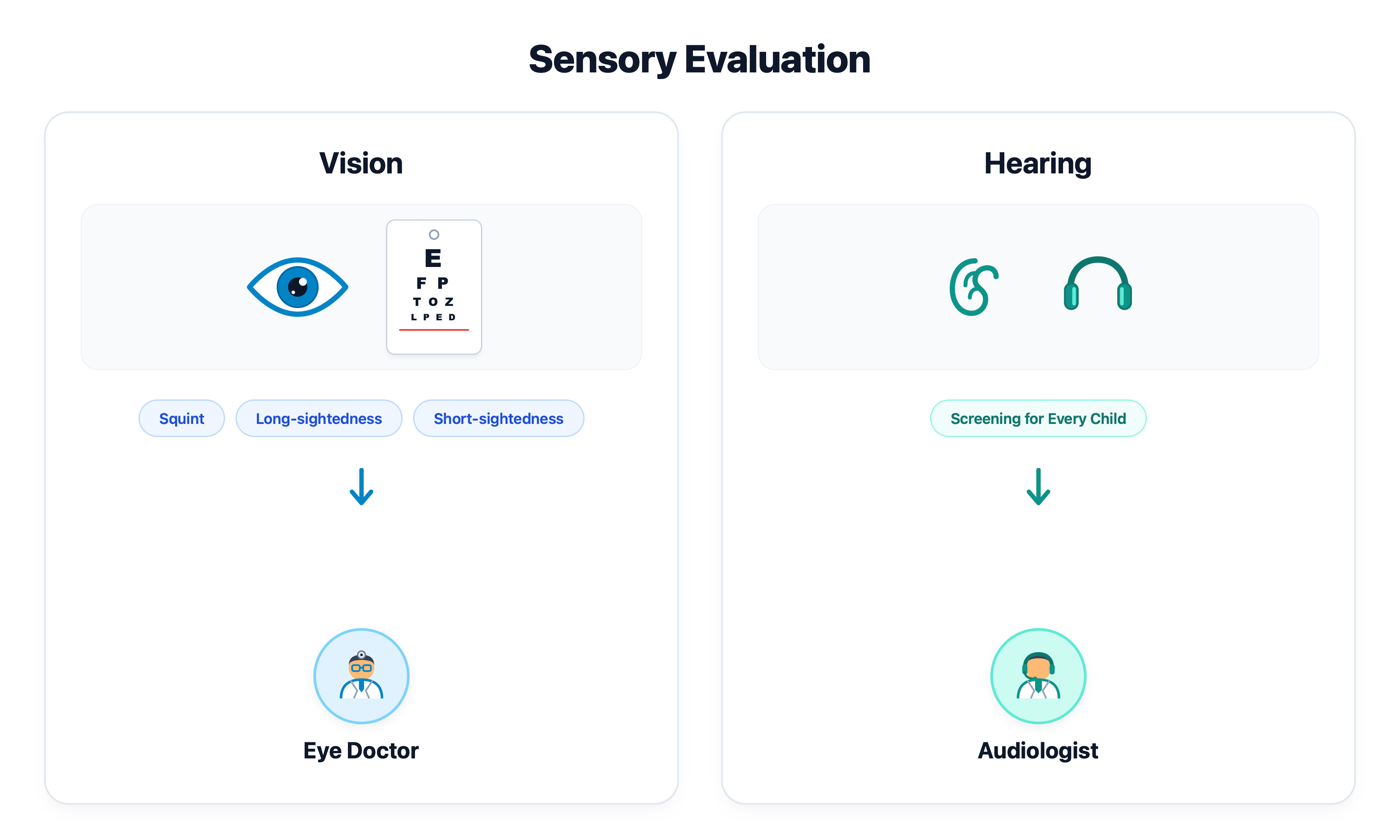
Sensory evaluation: vision and hearing
| Vision | Hearing | |
|---|---|---|
| Why | Squint (strabismus), long-sightedness (hyperopia) and short-sightedness (myopia) are common in children with developmental disabilities | Every child suspected of ASD should have hearing screening by a suitable method |
| What is done | Questions on and observation of functional vision during the diagnosis itself; recording eye movements (extra-ocular movements), pupil responses and eye structure; screening by methods suited to infants, toddlers and pre-school children (functional vision screening / other standard methods) | If there is concern, refer for a formal hearing assessment; if screening cannot be done, or the child fails it, refer to a paediatric audiologist |
| Refer to | A paediatric ophthalmologist or an optometrist if parents / professionals are concerned | Paediatric audiologist |
| Special note | Methods should meet the professional standards of that field | Uncooperative children may need sedation for auditory brainstem evoked potentials (ABR / BERA). Newborn screening alone is not enough - hearing loss may come later from injury or illness (repeated ear infections) in infancy and childhood |
Exam focus: Minimum genetic tests = high-resolution karyotype + Fragile X DNA probe (FMR1). Rett's = MECP2 test. The overall risk of ASD for siblings is about 6%. Pica → lead screening; failure to thrive → thyroid; cyclic vomiting → metabolic screening. Landau-Kleffner = acquired epileptic aphasia → sleep / video EEG. Hearing screening for every child suspected of ASD; newborn screening is not enough.
Memory code: "Pica-Lead, Growth-Thyroid, Vomit-Metabolic" - pica → lead; growth deficiency → thyroid; cyclic vomiting → metabolic screening. "Karyo + Fragile = minimum two".