Purpose of medical evaluation (AAP)
- The American Academy of Pediatrics (AAP) has made recommendations on the paediatrician's role in the diagnosis and management of autism.
- According to the AAP, the purpose of the medical evaluation is to find the cause (etiology) of the disorder, the medical conditions that occur with it, and other health problems.
- Benefits of knowing the cause and associated conditions: genetic counselling; family counselling to understand the cause; treatment options; information on the future (prognosis); the chance of primary and secondary prevention; a complete data bank for studies of how common the disorder is (epidemiology).
- New information, including new genetic syndromes, keeps coming, so doctors who want expertise in autism must stay involved in the care of children with ASD and keep up with the latest research.
The medical examination has 2 types: (1) the physical and neurodevelopmental examination; (2) the developmental neurological examination.
Physical and neurodevelopmental examination
- A thorough physical examination that includes a neurodevelopmental examination is an essential part of the medical evaluation of a child with ASD. It should be done by a qualified health professional with expertise in ASD.
- Purpose - to look for signs of:
- genetic disorders
- growth abnormalities: small head (microcephaly), large head (macrocephaly), enlarged organs (organomegaly)
- abnormalities of the sense organs: for example, clouding of the lens of the eye (cataract)
- neurocutaneous syndromes: neurofibromatosis, tuberous sclerosis
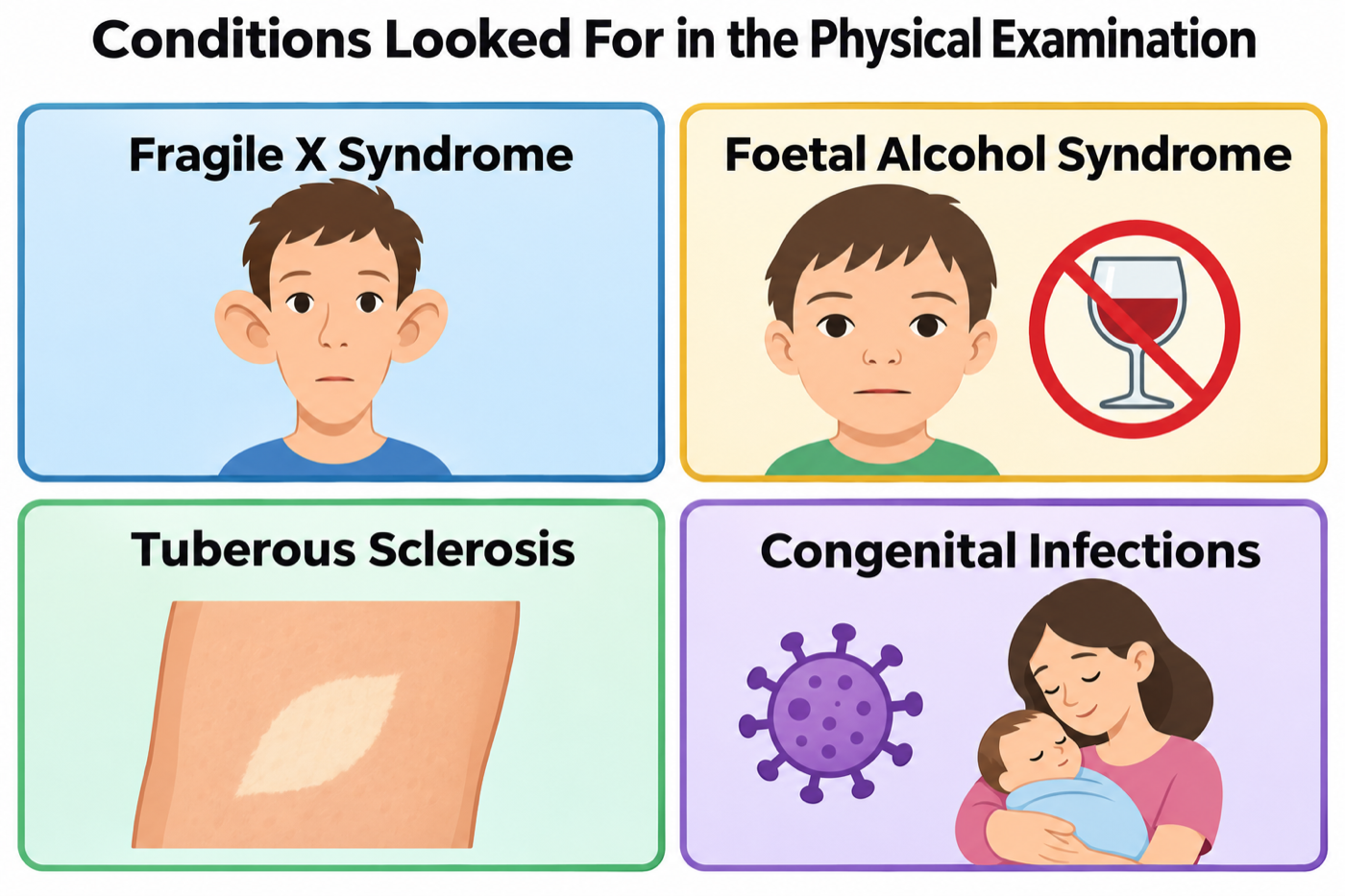
Common conditions that occur with ASD, or that must be examined in differential diagnosis:
| Condition | Findings on physical examination |
|---|---|
| Fragile X syndrome | Prominent (protruding) ears (70%), high-arched palate (63%), hyperextensible finger joints (49%), long face (64%); seen in girls as well as boys, sometimes in a subtle form |
| Foetal alcohol syndrome | 4 conditions for diagnosis: a confirmed history of the mother drinking alcohol during pregnancy; growth delay; typical facial features; defects in the development of the central nervous system. Growth deficiency = low birth weight for gestational age, weight loss over time (not due to nutrition alone), or low weight for height. Facial features = short eyelid openings (palpebral fissures), a thin upper lip, a flat groove between the nose and the lip (philtrum). Those who do not fully meet these conditions are considered under alcohol-related birth defects (heart, kidneys, bones, eyes, ears) or alcohol-related neurodevelopmental disorder |
| Tuberous sclerosis | By age 5, 50% of children have small bump-like lesions on the face (fibrous angiomata); pale "ash-leaf" spots on the skin elsewhere; pit-like defects in tooth enamel; hamartomas in any organ - heart, kidneys, gums, under the nails; frequent seizures in infancy / early childhood |
| Congenital infections | Children with congenital infections, with or without symptoms, may later show ASD features; for example, congenital cytomegalovirus infection - small head, hearing loss that appears later, enlarged liver (hepatomegaly) |
Developmental neurological examination
- Purpose: to see whether there are developmental neurological abnormalities compared with the neurological functioning expected at the child's chronological age. These may point to other developmental disabilities or co-occurring conditions, or show that further neurological laboratory tests are needed.
- Main parts:
- head circumference
- cranial nerve function
- cerebellar function
- deep tendon reflexes
- postural reactions
- primitive reflexes
- motor examination: active and passive muscle tone, strength, involuntary movements
- tests of gross and fine motor coordination
- abnormal reflexes and signs such as the Babinski response
Exam focus: The medical examination has 2 types: physical-neurodevelopmental examination and developmental neurological examination. AAP: medical evaluation = finding the cause and associated conditions. Fragile X = prominent ears (70%), long face (64%); tuberous sclerosis = ash-leaf spots, facial lesions in 50% by age 5; foetal alcohol = thin upper lip, flat philtrum. Babinski response in the neurological examination.
Memory code: "Ears 70, Palate 63, Face 64, Fingers 49" - the percentages of Fragile X features. "Ash-leaf = Tuberous" - a pale leaf-shaped spot should bring tuberous sclerosis to mind.