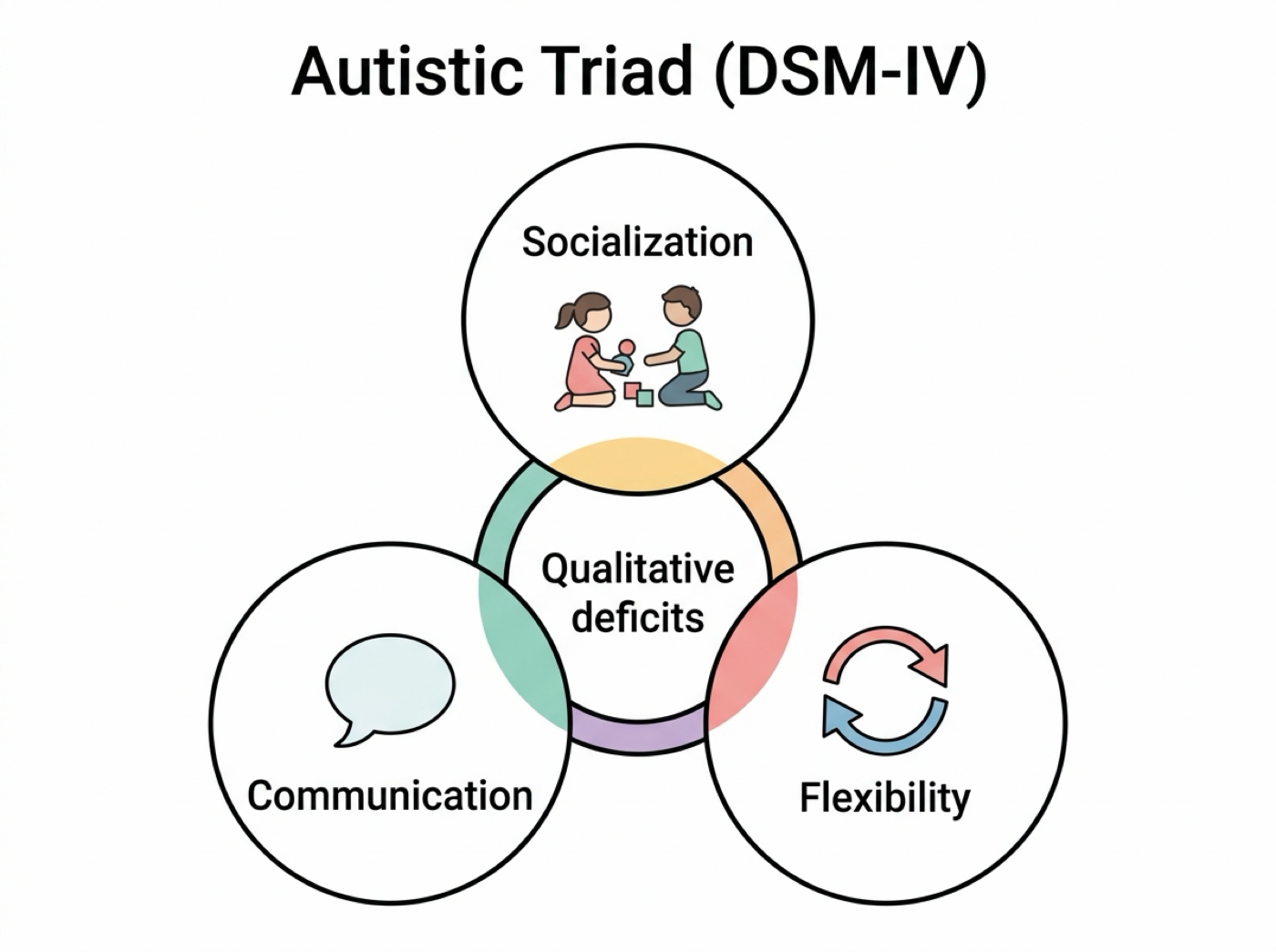
According to DSM-IV, autism is a developmental disorder that comes under Pervasive Developmental Disorders (PDD). It has three qualitative deficits. Together these three are called the "Autistic Triad":
- Lack of Socialization
- Lack of Communication
- Lack of Flexibility
Previous papers questions asked in the exam on what you just read
Qualitative deficits of 'Autistic Traiad' are
- (1)Lack of understanding, Emotion, Development
- (2)Lack of awareness, speech, communication
- (3)Lack of socialization, communication, flexibility
- (4)Lack of sensitization, development, reasoning
Answer & explanation
Correct answer: (3) Lack of socialization, communication, flexibility
The question asks for the three qualitative impairments that make up the 'triad of impairments' in autism.
Lorna Wing and Judith Gould described autism through three core areas of difficulty: social interaction (socialization), such as poor eye contact and difficulty relating to people; communication, such as delayed speech, echolalia and not understanding gestures; and flexibility of thought and behaviour (social imagination), such as resistance to change and repetitive activities. So the answer is option (3).
Option (1) includes 'development' and 'emotion', which are not the triad. Option (2) lists speech and communication, which are both parts of a single area, and leaves out social and flexibility deficits. Option (4) lists terms that are not related to the triad.
Remember: Autistic triad = Social, Communication, Flexibility.
1. Lack of Socialization
- Deficit in social-emotional reciprocity.
- Deficit in forming, keeping and understanding relationships with parents, friends and siblings.
- Deficit in eye contact.
- Pretend play and turn taking do not come properly.
- Cannot ask for help or help others.
- There is an attention deficit; the child needs someone to watch over their tasks and experiences.
2. Lack of Communication
- Deficit in the verbal and non-verbal communicative behaviours used in social interaction.
- Echolalia - repeating the words and phrases said by others exactly as they are.
- Pronominal Reversal - saying "you" instead of "I"; e.g. saying "Do you want water?" to mean that he himself wants water.
- Immediate and delayed verbal imitation.
- Speaking in one flat tone, without rise and fall (Monotone).
- Using meaningless words or made-up words (Jargon).
- Lack of Joint Attention - unable to focus on the same object/event together with another person.
- Not using emotional and body gestures.
Previous papers questions asked in the exam on what you just read
Repeating words, phrases or repeating what other person say is called
- (1)Aphasia
- (2)Dysphasia
- (3)Echolalia
- (4)Cued speech
Answer & explanation
Correct answer: (3) Echolalia
The question asks for the name of the speech behaviour in which a person repeats words or phrases spoken by someone else, often without understanding them.
This behaviour is called echolalia ('echo' + 'lalia', meaning speech). If the repetition happens right after hearing, it is immediate echolalia; if it happens hours or days later, it is delayed echolalia. It is very common in children with Autism Spectrum Disorder. For example, when the teacher asks "What is your name?", the child replies "What is your name?". So the answer is option (3) Echolalia.
Aphasia (1) is the loss of language already learnt, due to brain damage. Dysphasia (2) is a partial loss of the same language ability. Cued speech (4) is a communication method for persons with hearing impairment that adds hand cues to lip movements. None of these means repeating what others say.
Remember: Echolalia = speech that comes back like an echo.
Children with Autism often repeat the same what we say is called
- (1)Aphasia
- (2)Dysphasia
- (3)Echolalia
- (4)Somalia
Answer & explanation
Correct answer: (3) Echolalia
The question asks the name for the habit of children with autism repeating exactly what others say.
'Echo' means a returning sound and 'lalia' means speech. Repeating someone's words instead of answering them is called echolalia. For example, when asked 'What is your name?', the child says 'What is your name?' back. It is a common language feature of autism.
So the answer is option (3), Echolalia.
Aphasia (1) is loss of language due to brain damage. Dysphasia (2) is partial impairment of language. Somalia (4) is the name of a country in Africa, a distractor.
Remember: Echolalia = echoing back what is heard.
Echolalia means
- (1)Listening to what others say
- (2)Repeating what someone else said
- (3)Not listening to what others say
- (4)Not speaking
Answer & explanation
Correct answer: (2) Repeating what someone else said
The question asks for the meaning of the term echolalia.
"Echo" means a repeated sound and "lalia" means speech. Echolalia is repeating the words or questions of another person, often without understanding them. If you ask "What is your name?", the child answers "What is your name?". It is common in children with Autism and is also seen in some children with intellectual disability. It can be immediate (repeated at once) or delayed (repeated later).
So the answer is option (2), Repeating what someone else said.
Listening (1) and not listening (3) are about hearing and attention, not about the child's own speech. Not speaking (4) describes mutism; in echolalia the child does speak, but only echoes what was heard.
Remember: Echo-lalia = echoing speech.
One of the characteristics of Autism is
- (1)Unable to speak
- (2)Repeating the same words
- (3)Adding new words to the given words
- (4)Not responding to the words
Answer & explanation
Correct answer: (2) Repeating the same words
The question asks which of the given behaviours is a characteristic of autism.
Autism Spectrum Disorder is marked by difficulty in social interaction, problems in language and communication, and restricted, repetitive behaviour. A typical language feature is echolalia: repeating words or phrases spoken by others, without using them meaningfully. For example, when asked "What is your name?", the child repeats "What is your name?" instead of answering.
So the answer is option (2), Repeating the same words.
Some autistic children do not speak, but this is not true of all of them, so option (1) is not the defining feature. Adding new words to what is said, option (3), is not an autism trait. Not hearing words, option (4), points to hearing impairment; autistic children can hear, even when they do not respond.
Remember: Echolalia = repeating heard words → autism.
3. Lack of Flexibility
- Stereotyped or repetitive motor movements, use of objects and speech.
- Insistence that everything stays the same (Maintenance of Sameness).
- Highly restricted, fixated interests that are unusual in intensity or focus.
- Self-injurious activities.
- Self-stimulatory activities - such as rocking and hand flapping.
- Low or high response to the senses (Hypo and Hyper reactivity to sensory input).
Exam focus: Autistic Triad (DSM-IV) = Lack of Socialization, Communication, Flexibility. Echolalia = repeating others' words (a main communication feature of autism). Pronominal reversal = mixing up "I/you". Self-stimulatory and self-injurious behaviours come under the lack of flexibility.
Memory code: To keep the two triads apart: Wing's triad is SCI (ends with Imagination), the DSM-IV Autistic Triad is SCF (ends with Flexibility). Echolalia = echo - repeating words that were heard.