The 5-type division described above is now only history. The American Psychiatric Association released DSM-5 in 2013 and DSM-5-TR in 2022.
What changed?
- Autistic Disorder, Asperger's Disorder, PDD-NOS and CDD are no longer separate names; they are all merged into one "Autism Spectrum Disorder" (single spectrum).
- People with a well-established DSM-IV diagnosis of Autistic Disorder, Asperger's Disorder or PDD-NOS should now be given the diagnosis of ASD.
- Because the genetic cause of Rett Syndrome (MECP2) is known, it is now seen as a separate genetic condition and not as a type of ASD.
- The old "Triad" (3 areas) has now become 2 areas (Dyad): social communication + social interaction together form one area (A), and restricted-repetitive behaviours form the second area (B).
- Over- or under-response to the senses (sensory issues) was added to the diagnostic criteria (B4).
DSM-5 Diagnostic Criteria A-E
A. Persistent deficits in social communication and social interaction - across many situations; all three must be present:
- Deficit in social-emotional reciprocity - unusual social approach, no back-and-forth conversation, not sharing interests and feelings, not starting or not responding to interaction.
- Deficit in the non-verbal behaviours used in social interaction - eye contact, body language, gestures and facial expressions are poor or absent.
- Deficit in forming, keeping and understanding relationships - cannot change behaviour to suit the situation, cannot share imaginative play, cannot make friends, no interest in peers.
B. Restricted, repetitive behaviours, interests and activities - at least 2 of these 4 must be present:
- Stereotyped / repetitive movements, use of objects or speech (e.g. simple motor stereotypies, lining up toys, spinning objects, echolalia, idiosyncratic phrases).
- Insistence on sameness, inflexible routines, ritualized behaviour (e.g. great distress at a small change, wanting the same route and the same food every day).
- Highly restricted, fixated interests that are unusual in intensity or focus (e.g. strong attachment to unusual objects).
- Hyper- or hypo-reactivity to sensory input, or unusual interest in sensory aspects of the surroundings (e.g. clear indifference to pain / heat / cold, negative response to certain sounds and textures, excessive smelling / touching of objects, fascination with lights and spinning objects).
C. Symptoms must be present in the early developmental period. (They may not fully show until social demands go beyond the child's limited abilities; later they may be masked by learnt strategies.)
D. Symptoms must cause clinically significant impairment in present social, occupational or other important areas of functioning.
E. These symptoms must not be better explained by Intellectual Disability or Global Developmental Delay. (ID and ASD often occur together; to diagnose both together, social communication must be below the child's general developmental level.)
Severity Levels
Severity is stated separately for both A (social communication) and B (restricted-repetitive behaviours).
| Level | Name | Meaning |
|---|---|---|
| Level 1 | Requiring support | Mild; without support, social difficulties are noticeable |
| Level 2 | Requiring substantial support | Moderate; clear deficits even with support |
| Level 3 | Requiring very substantial support | Most severe; severe deficits in daily functioning |
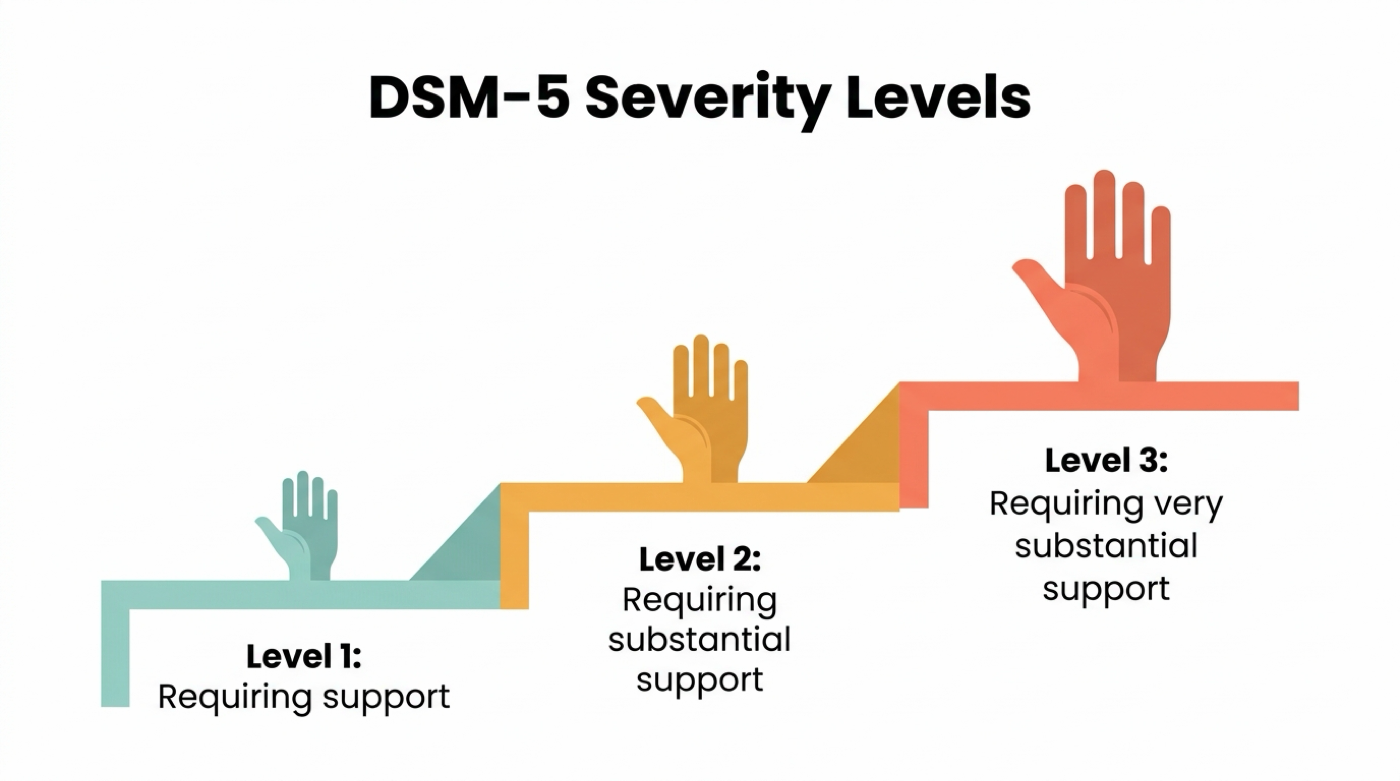
Exam focus: DSM-5 (2013) / DSM-5-TR (2022) - one Autism Spectrum Disorder; Asperger's, PDD-NOS and CDD are no longer separate diagnoses. Criteria: A (all 3) + B (at least 2 of 4) + C + D + E. 3 severity levels: Level 1 - support, Level 2 - substantial support, Level 3 - very substantial support. Sensory problems were added in B4.
Memory code: "A: all 3, B: 2 of 4" - all 3 points of A, at least 2 of the 4 points of B. As the severity level rises, support rises: 1 support → 2 substantial → 3 very substantial. DSM-5 = 2013, DSM-5-TR = 2022 ("5 in '13, TR in '22").