Cognitive Behavioural Therapy (CBT)
- CBT = Cognitive Behavioural Therapy. It is an intervention that combines cognitive (thinking) principles and behavioural learning principles.
- Its aim is to bring change in a person's behaviour, thinking and understanding.
- Its idea is that errors in the way of thinking (cognitive patterns) lead to changes in behaviour, and that correcting them changes behaviour.
- It is mostly useful for managing anxiety and anger in older children with ASD who can speak.
Deficit in Theory of Mind
- Theory of mind is the ability to understand that oneself and others have thoughts, feelings and beliefs, and to predict behaviour on that basis.
- In people with autism this ability is weak. Without deliberate training it is almost impossible for them to see things from another person's point of view.
- That is why they struggle to know what others are thinking and how others will understand things. They also have deficits in social behaviour and difficulty in using signs and cues.
Social Stories
- One of the most useful methods for teaching social skills. Carol Gray (1993) said that strategies can be developed through social stories.
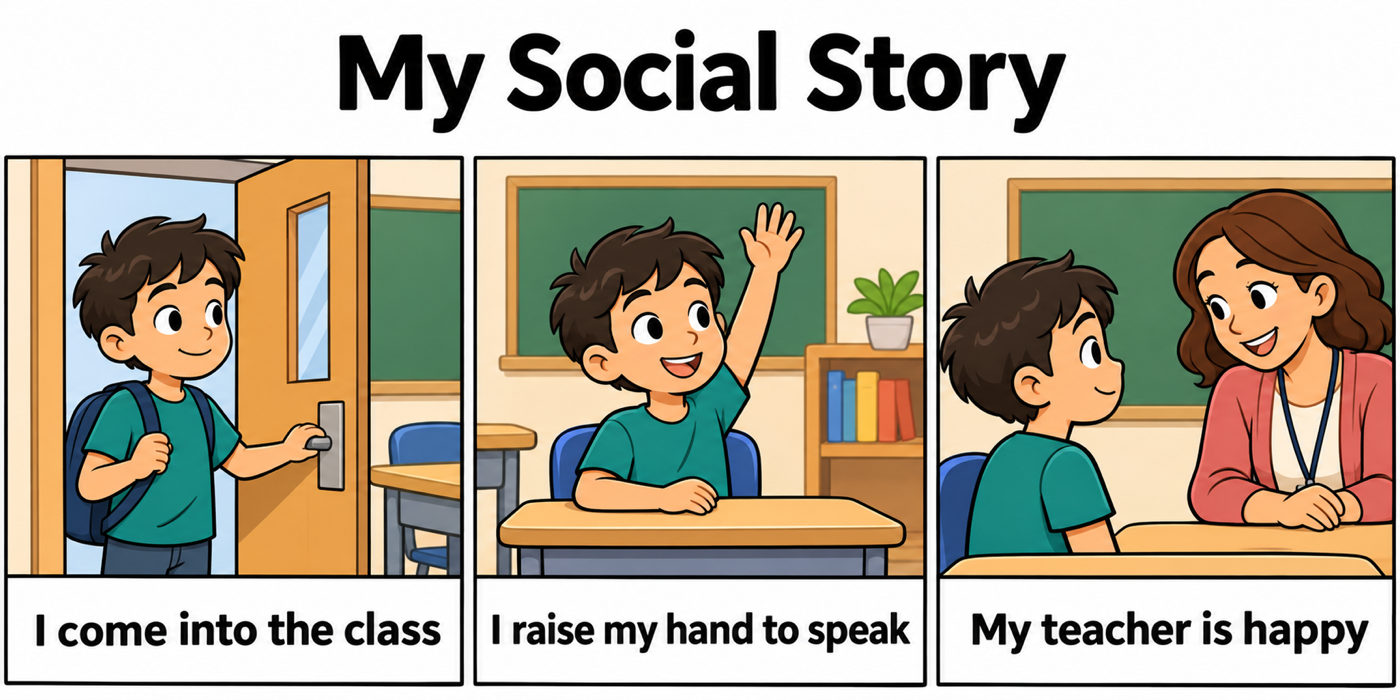
- A social story describes a social situation, the social cues in it and the correct responses. It is written for a particular student about a particular situation.
- It is used to introduce situations such as a new routine or changes in advance. It explains the reasons for other people's behaviour.
- When writing the story, consider the student's level of understanding and reading level. The story contains descriptive sentences, directive sentences and perspective sentences. The student's hearing and vision problems must also be taken into account.
- Situations where social stories are useful:
- Teaching a new routine: it can be taught together with pictures or pictographs.
- Transitions: giving advance warning with visual cues before moving from one activity to another.
- Changing the topic in conversation: some students become experts on one topic and talk only about it. Teach with visual rules when and where the favourite topic may be discussed.
- Starting a new lesson topic: guiding the student towards the goal with specially made charts.
- Discipline: showing visually which behaviour is expected in particular situations.
- Cognitive picture rehearsal: practising a sequence of behaviour again and again with pictures.
Strategies for teaching social skills
- Many students with ASD want friends and want to fit in. But reading, understanding and responding to social cues is hard for them. So they may, without meaning to, say or do things that annoy or hurt others.
- Difficult social skills: social conversation; understanding and using gestures, facial expressions and body language; starting, keeping up and ending a conversation; social customs and conventions.
- These need both systematic teaching and practice within natural routines.
- Effective strategies: rules, social stories, role play, scripts, cue cards, checklists, coaching, modelling and friendship groups.
- Teach the social rules of the class and post them on the wall. Rules should be concrete and positive. Example: "We use our inside voices (speak softly) so that everyone can finish their work."
- Make sure facial expressions are clear, and build interest in relating to others.
- Give opportunities to be with others and to hold conversations. Assess and develop reciprocal social skills.
Exam focus: CBT = cognitive principles + behavioural learning principles. Social stories = Carol Gray (1993). Because of the theory of mind deficit, other people's point of view is not understood. Social rules should be written in a concrete, positive way.
Memory code: "Gray Stories '93" - Carol Gray, social stories, 1993. "CBT = Think + Do": Cognitive (thinking) + Behavioural (doing).