What is identification, and what is assessment?
- Identification: finding children from birth to 5 years of age who are most likely to have ASD or a developmental delay, and starting a full evaluation for them.
- Assessment: collecting detailed information about the identified child to decide what help and what teaching plan he needs. In other words, assessment serves intervention planning.
Identifying autism in India: the earlier picture
- For a long time, autism was diagnosed very rarely in India. Before 1970, only a few scattered cases were diagnosed.
- Only a handful of doctors in big cities could identify children with autism accurately. Many children never came to medical attention, and even medical experts did not agree with one another.
- Until about twenty years ago there was no precise method of diagnosis, so autism looked very rare; it was often recognised only as a "special case".
- Identification becomes easier when parents, and sometimes brothers and sisters, notice and report the signs and weaknesses they see in the child.
Why is autism hard to diagnose?
- There is no medical test, such as a blood test or a genetic test, that diagnoses autism.
- Diagnosis is made only by watching the child's behaviour carefully and by asking family members about his development.
- That is why an experienced specialist is essential for diagnosing autism.
- Other conditions, such as intellectual disability, may occur along with autism; this makes diagnosis even more complicated.
- Although various psychometric tools are available, no single tool allows a quick diagnosis. Diagnostic criteria such as DSM-IV-TR and DSM-5 exist, but they alone are not enough; a specialist's detailed examination is needed.
At what age can it be identified?
| Stage | What happens |
|---|---|
| First year | In some children differences may appear in the first months; in others, at any time during the first year |
| 12-18 months | Signs of autism can usually be identified at this age |
| About 1½ - 2½ years | Many children show a halt in development, a loss of social skills and no speech |
| 2nd or 3rd year | Experts say a diagnosis can be made by this age |
| 30-36 months | A screening test can be done even at this age, focusing on early concerns and skills, followed by referral for a detailed assessment |
- The American Academy of Pediatrics (AAP) recommends that a paediatrician carry out autism-specific screening for every child at 18 months and 24 months of age.
- Tools for screening and diagnosis are now available for use during routine well-child check-ups.
- After early identification, an intervention plan should be made that focuses on developing the child's speech and social skills. Special education teachers and medical experts must work together on this, and parents play a key role at this stage.
- For children older than four, diagnosis depends on their behaviour and symptoms. Problems in communication, socialisation and restricted behaviours must be identified for the diagnosis.
- Autism is more common in boys than in girls. For any child (boy or girl) who screens positive, medical experts should make an autism diagnosis only after a detailed investigation.
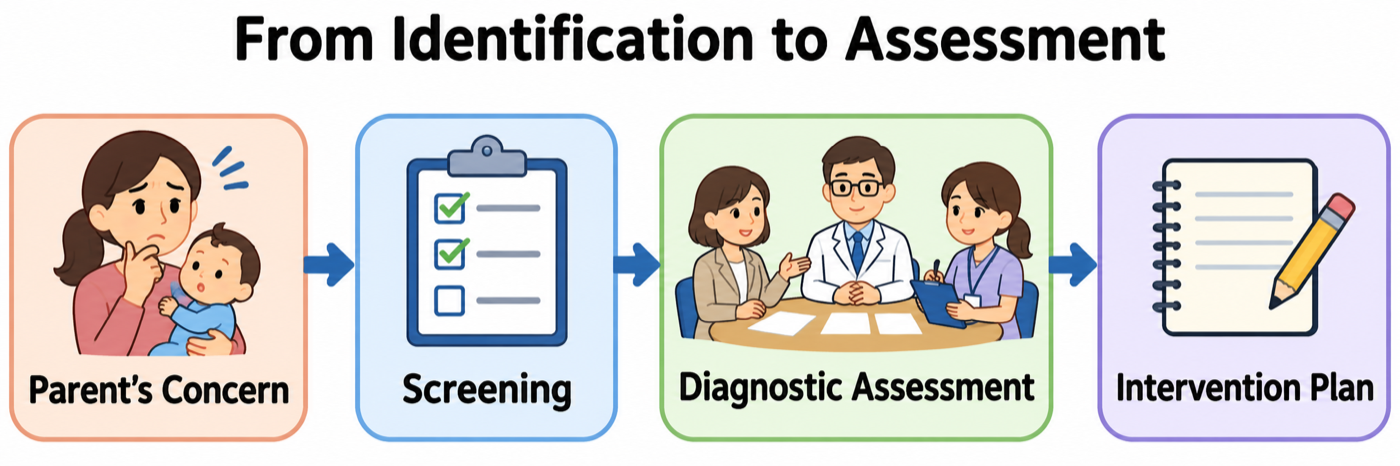
Exam focus: There is no medical / blood / genetic test for autism; diagnosis rests on behaviour observation + the developmental history given by the family. Signs at 12-18 months; autism screening at 18 and 24 months (AAP). Identification = finding at-risk children from birth to 5 years; assessment = information for intervention planning.
Memory code: "No Test, Just Watch" - autism has no medical test; observing behaviour is the basis. Age chain "12-18 Signs, 18-24 Screen": signs appear at 12-18 months, screening at 18 and 24 months.