Physical, teaching and social changes in the curriculum and in the classroom make it easy to include students with hearing loss and increase their ability to learn.
Classroom acoustics: three enemies
| Problem | Meaning | How to reduce it |
|---|---|---|
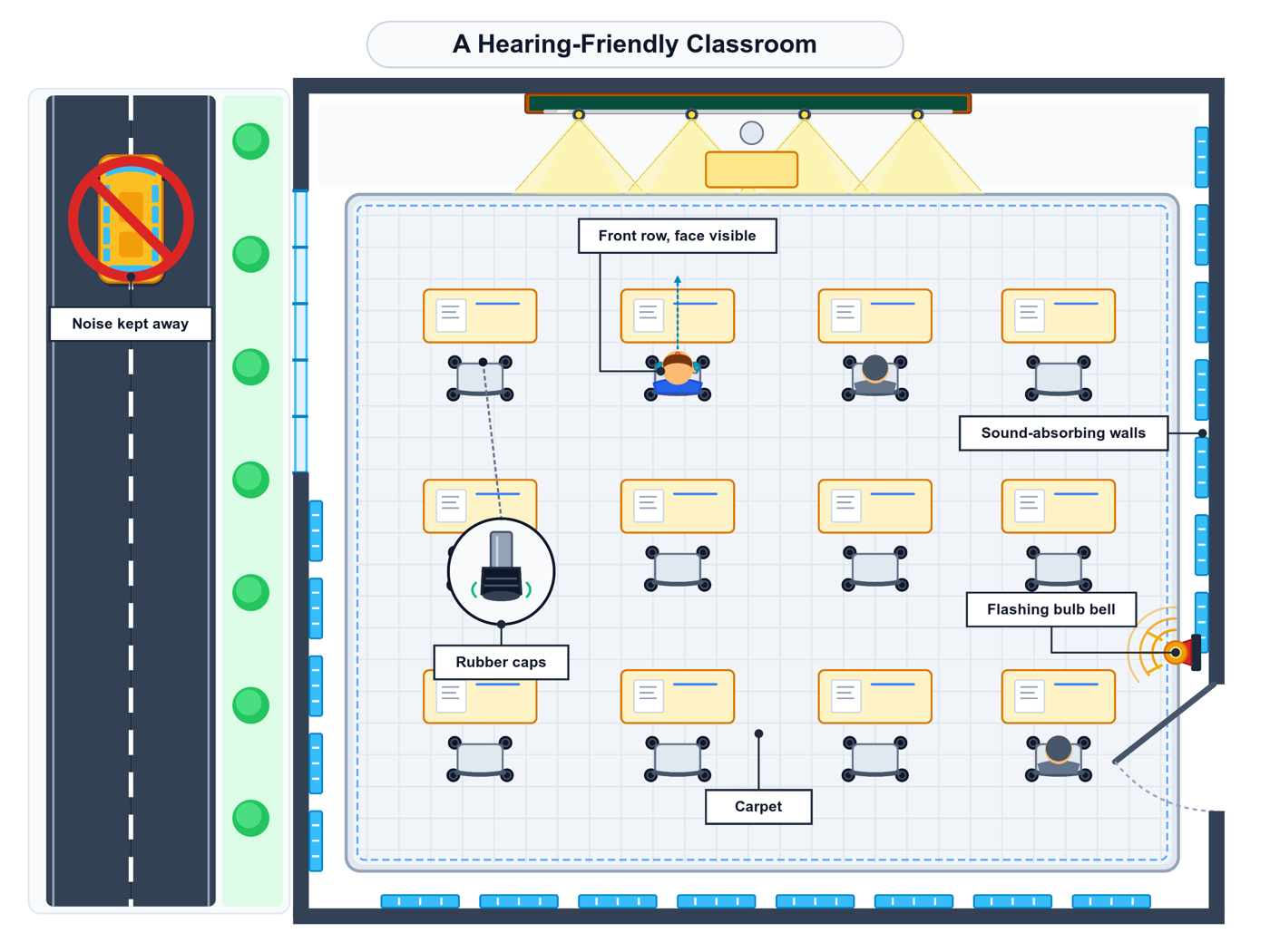
| Background noise | Fans, vehicles, outside noise, chairs being dragged | Do not build a school where there is a lot of noise, such as near a bus stand or railway station; windows and doors should shut properly; rubber caps on furniture legs |
| Reverberation | Sound bouncing again and again off hard floors, walls and the ceiling, so words overlap | Carpet on the floor; covering the walls with sound-absorbing perforated sheets and soft wooden panels, with charts and pictures pasted on them |
| Low signal-to-noise ratio (SNR) | The teacher's voice is not loud enough above the background noise | Seating the child close to the teacher; an FM system; reducing noise |
- Under the US classroom acoustics standard (ANSI S12.60), in an ordinary-sized empty classroom the background noise should not exceed about 35 dB, and the reverberation time should be under about 0.6 seconds. It is recommended that the teacher's voice be at least 15 dB above the background noise (a signal-to-noise ratio of +15).
- People with hearing loss cannot hear the school bell; so flashing bulbs (light signals) should be fitted in the classroom.
Memory code: Acoustics standard "35 - 0.6 - 15" - background noise under 35 dB, reverberation under 0.6 seconds, voice 15 dB above the noise. Three enemies "NRS" - Noise, Reverberation, low SNR.
Seating and physical changes
- Seat the student with hearing loss in the front row, facing the blackboard, in good light and close to the teacher; not in the path where everyone walks. (Not near the window, in the last row or near the door.)
- From his seat he should be able to see the teacher's face, the board, the projector and, during discussion, as many classmates as possible.
- The classroom should be spacious, suitable for teaching, airy and well lit.
- Light should fall on the blackboard, and it should be at the students' eye level.
- A thick carpet on the floor and sound-absorbing perforated sheets on the walls absorb sound inside the room; they reduce echo and footstep noise.
Previous papers questions asked in the exam on what you just read
A child attends with hearing aid to regular classroom. He asked to sit in
- (1)Near to window
- (2)First row
- (3)Last row
- (4)Near to door
Answer & explanation
Correct answer: (2) First row
The question asks where a child wearing a hearing aid should sit in a regular classroom.
A hearing aid amplifies nearby sounds best; the teacher's voice becomes weaker as the distance grows. These children also understand by watching the teacher's lips and face. So the child should sit in the first row, close to the teacher, with a clear view of the teacher's face.
So the answer is option (2), First row.
Near the window (1) or the door (4) there is more outside noise, and the hearing aid amplifies that noise too, which confuses the child. The last row (3) is far from the teacher, and the teacher's lips cannot be seen.
Remember: Hearing-impaired child: front row, away from noise.
Teaching and social changes
- The teacher should speak in short, meaningful sentences; explain by doing things with the hands rather than with many words; teach through small experiments.
- Explain things while writing them in short sentences; use various signs, body movements and facial expressions.
- Keep calling students by name; make a rule that they raise their hands before answering - this keeps the class free of confusion and noise.
- Check whether the lesson has been understood; give chances to ask questions.
- Encourage them to take part in all activities - especially reading, conversation, telling short stories and plays.
- Make parents aware of the children's difficulties and achievements.
- To introduce ideas such as colours, the lecture-cum-demonstration method (explanation with demonstration) is suitable.
- When teaching students with hearing loss in a regular class, the teacher should show the main points in point form with an overhead projector; she should not walk up and down while explaining.
Previous papers questions asked in the exam on what you just read
The appropriate teaching method to introduce colours to the children with hearing impairment is
- (1)Lecture method
- (2)Demonstration method
- (3)Lecture cum demonstration method
- (4)Project method
Answer & explanation
Correct answer: (3) Lecture cum demonstration method
The question asks which method suits introducing colours to children with hearing impairment.
Children with hearing impairment learn mainly through sight, so the colour must be shown. But the child must also learn the name of the colour, that is, the language. So the teacher shows a coloured object and at the same time says its name clearly with the face visible for speechreading, uses a sign and writes the word on the board. Telling and showing go together, in the spirit of total communication.
So, as per the official key, the answer is option (3), Lecture cum demonstration method.
Many students choose (2), Demonstration method. Showing alone gives the colour but not its name; the verbal part is needed to build language. Lecture alone (1) does not suit children who cannot hear well. Project method (4) is for longer tasks with older children, not for introducing a basic concept like colours.
Remember: Show + tell together = lecture cum demonstration: the colour and its name.
Improving oral communication: Garwood (1987) "SPEECH"
| Letter | Suggestion |
|---|---|
| S | Explain a point briefly and directly |
| P | Speak at a moderate pace without breaks |
| E | Make things clear through lip movements |
| E | Express with enthusiasm, using body movements and language symbols |
| CH | When changing the topic, make it clear in a way that suits the student's power of understanding |
Changes in teaching materials
- Written teaching material is key to building speaking ability: various pictures, drawings, graph paper, charts and flash cards.
- Toys that make sounds and various objects also build language ability.
- Adapt the material to suit them, remake it so that it is easy to understand, and explain it.
- Telling, writing and classifying based on objects, toys, charts and flash cards build descriptive power, conceptual power, speaking and writing skills.
- Abstract ideas should be linked to real experiences and presented in writing.
Peer tutoring and small groups
- Peer tutoring: training students to teach one another; two, three, and sometimes four or five working together on the same task. A peer explains the main points of the lesson clearly with classroom examples. This greatly helps the subject learning of students with hearing loss.
- Buddy system (small-group teaching): teachers should become skilled at forming small groups, teach how to work in a group, and give each group a specific task. This builds language and speech; things not understood become clear through peers; social development and communication ability grow.
Exam focus: A child with a hearing aid should be seated in the front row. A flashing bulb instead of the bell. Carpet, sound-absorbing walls and rubber caps on furniture reduce reverberation and noise. Garwood (1987) = SPEECH. The teacher should not speak while walking about or writing on the board. To teach colours, the lecture-cum-demonstration method.
Memory code: "SPEECH - Garwood 87": S short and straight, P pace (moderate), E easy-to-read lips, E enthusiasm, CH change of topic with care. Seat "FFL" - Front row, Facing the board, in the Light.