- If autism is caught in infancy, the brain's remarkable ability to change at a young age (brain plasticity) can be fully used in treatment.
- Diagnosis before 24 months is hard. But the signs often appear between 12 and 18 months.
- If signs are spotted before 18 months, intensive treatment may help reshape the brain and reduce the symptoms.
- Autism signs can be reliably detected by the age of 3; in some cases as early as 18 months. The signs are seen most clearly between 2 and 6 years.
- The early signs are not "the presence of unusual behaviour" but "the absence of behaviour that should normally be there". That is why they are hard to catch.
- Some infants with autism do not respond to cuddling, do not reach out to be picked up, and do not look at the mother's face while feeding.
Signs that show up as "absence"
Be alert if the child does not do these:
- Does not look into your eyes (no eye contact) - e.g. does not look at you while feeding.
- Does not smile back when you smile.
- Does not respond when his name is called or when he hears a familiar voice.
- Does not follow moving objects with his eyes.
- Does not use gestures such as pointing or waving bye-bye.
- Does not look where you point when you show him something.
- Does not make sounds to get your attention.
- Does not start a cuddle or respond to one.
- Does not imitate your movements and facial expressions.
- Does not reach out to be picked up.
- Does not play with others or share his enjoyment and interest.
- Does not ask for help or make other simple requests.
Warning signs by age (Red Flags)
| Age | Warning if this is missing |
|---|---|
| 12 months | No babbling or cooing |
| 12 months | No gestures (pointing, waving) |
| 16 months | Not even single words |
| 24 months | No spontaneous 2-word phrases |
| At any age | Loss of language or social skills once learnt (regression) |
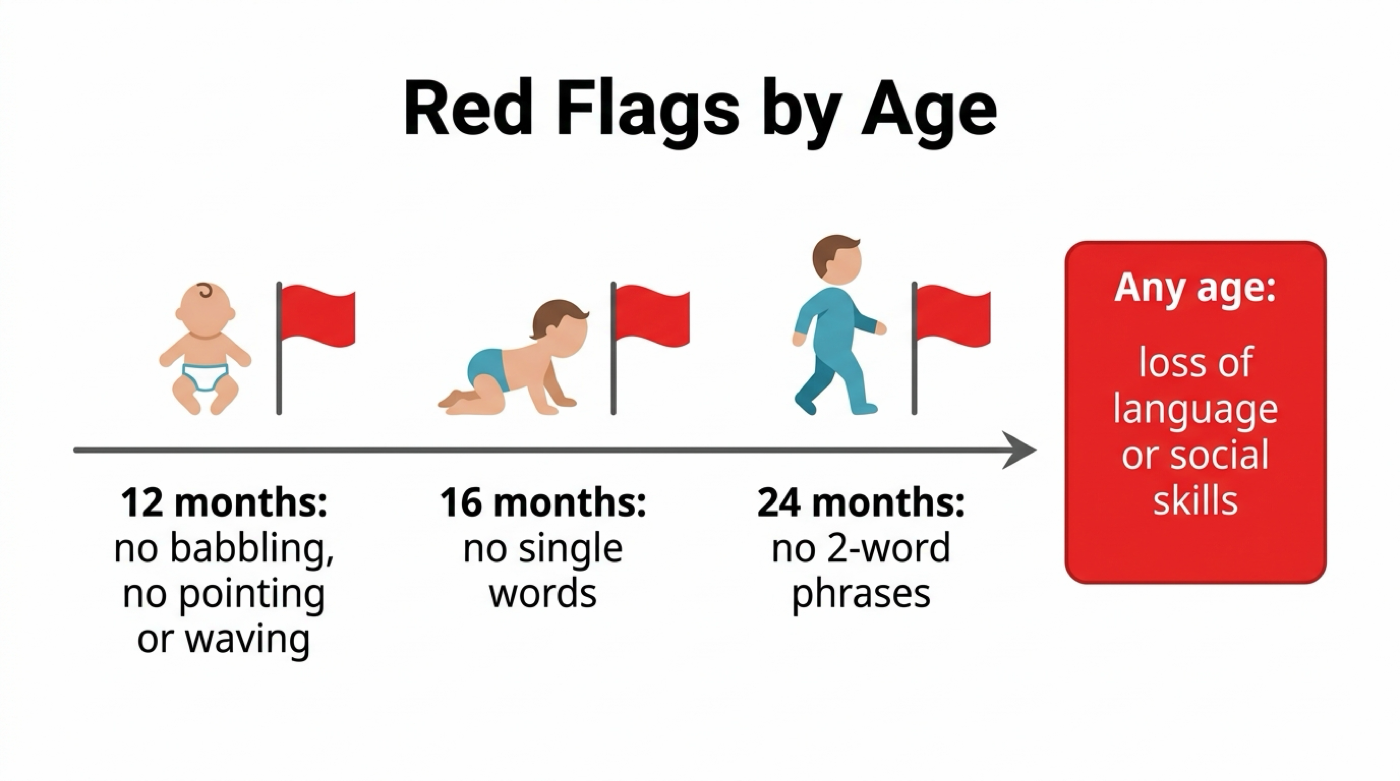
Exam focus: Signs appear between 12 and 18 months; diagnosis before 24 months is hard; spotting before 18 months gives the most benefit (brain plasticity). Early signs = absence of normal behaviours (eye contact, social smile, response to name, pointing). (Screening tools and assessment details come in the next chapter, "ASD: Identification and Assessment".)
Memory code: "12 - 12 - 16 - 24": 12 months - babbling, 12 months - gestures (pointing), 16 months - 1 word, 24 months - 2-word phrase. Remember "2 words at 2 years".