- Among the Pervasive Developmental Disorders, autism is the most common. Older estimates put it at 2 to 6 in every 1,000 people.
- It is not specific to any race, ethnic group or socio-economic status (SES); it appears almost equally, and with equal severity, in all groups.
- Older estimates: about 400,000 people in the USA; about 1.7 million people in India with autism or autism-like features. Another estimate says more than 2 million children in India may have autism.
- Older CDC (USA) estimate: one in every 68 children. Latest CDC report (2025, 2022 data): one in every 31 eight-year-old children (3.2%).
- WHO estimate (2021): about one in every 127 people worldwide.
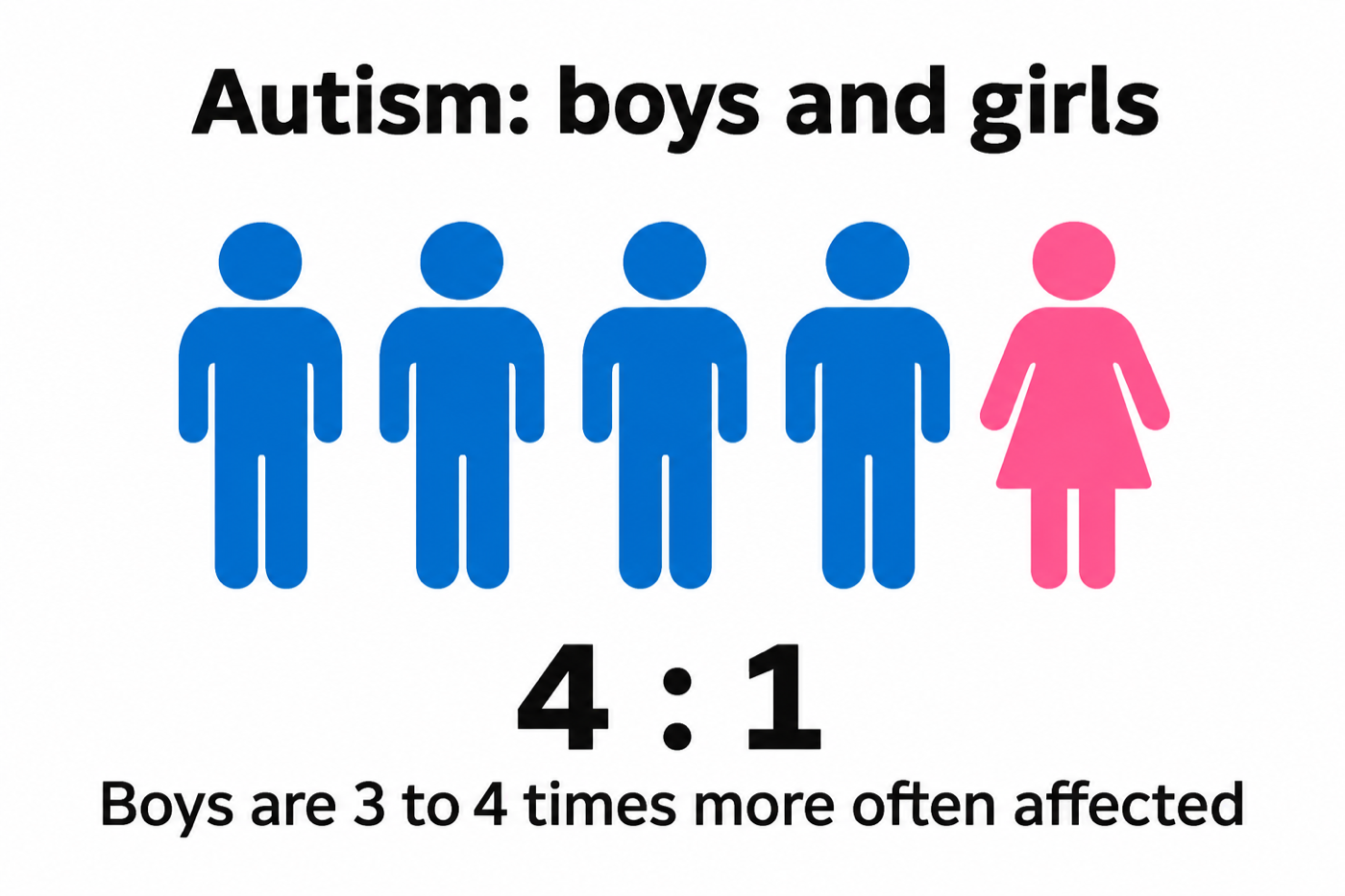
- Boys are affected 3 to 4 times more often than girls.
- Autism appears at all levels of intelligence. By an older estimate, about 75% have low intelligence and about 10% have high intelligence in some special areas. The level of intelligence varies a lot from person to person.
Myth and fact
- Myth: Autism is a condition found only in children.
- Fact: Autism is a lifelong condition. Children with autism grow up to become adults with autism. They often struggle from childhood to adolescence, so this chapter focuses mainly on children.
Previous papers questions asked in the exam on what you just read
One common misconception about autism is that: it is a condition that only effect children. But the truth is!
- (1)Autism does not affects the adults.
- (2)We cannot assess the autism in later stage.
- (3)We cannot diagnose the autism in adults in India.
- (4)Children with autism grow up to become adults with autism.
Answer & explanation
Correct answer: (4) Children with autism grow up to become adults with autism.
The question gives a myth, that autism affects only children, and asks what the truth is.
Autism is a lifelong neuro-developmental condition. It begins in early childhood but does not go away with age. Training and therapy improve skills, but the person remains autistic as an adult. So the truth is that children with autism grow up to become adults with autism, which is option (4).
Option (1) simply repeats the myth. Options (2) and (3) are also false: autism can be assessed and diagnosed in adolescents and adults too, and many people who were missed in childhood are diagnosed only as adults.
Remember: Autism is lifelong: autistic children become autistic adults.
Why is diagnosis a big problem?
- Autism is not rare. Even so, many people are not diagnosed and do not get the services they need.
- Awareness is very low, especially in countries like India. Misunderstandings exist not only among parents but also among medical professionals. This leads to misdiagnosis or under-diagnosis.
- Autism is identified more often in metro cities, where awareness, specialists and screening facilities are greater.
- That is why, in autism, diagnosis is the hardest task, even before intervention.
Previous papers questions asked in the exam on what you just read
The most difficult tasks in dealing Autism is
- (1)Rewarding
- (2)Diagnosis
- (3)Punishment
- (4)Scolding
Answer & explanation
Correct answer: (2) Diagnosis
The question asks which task is the hardest when dealing with Autism.
There is no blood test or scan that confirms Autism. It is diagnosed only by careful observation of behaviour and the child's developmental history, using screening tools and expert judgement. The signs vary widely from child to child (it is a spectrum) and overlap with speech delay, Intellectual Disability, hearing loss and ADHD. This makes diagnosis the most difficult task, so the answer is option (2) Diagnosis.
Rewarding (1) is a simple, routine teaching technique and not difficult. Punishment (3) and scolding (4) are practices teachers should avoid with these children; they are not tasks related to managing Autism at all.
Remember: No lab test for Autism, so diagnosis is the hard part.
Children with Autism are identified more here
- (1)Metro cities
- (2)Towns
- (3)Rural areas
- (4)Tribal areas
Answer & explanation
Correct answer: (1) Metro cities
The question asks where children with Autism are identified more often. The key word is "identified", not "born".
Autism is a neurodevelopmental condition. Identifying it needs aware parents, paediatricians, psychologists and screening tools. These facilities and this awareness are much greater in metro cities, so more cases of autism are diagnosed and recorded there.
So the answer is option (1), Metro cities.
Children with autism live in towns (2), rural areas (3) and tribal areas (4) too. But these places have fewer specialists and less awareness, so many children are never diagnosed. The lower numbers there show lower identification, not the absence of autism.
Remember: More awareness and specialists → more autism identified → metro cities.
AUTISM: features to remember by letters
| Letter | Feature |
|---|---|
| A | Alone even with others |
| U | Unusual play |
| T | Twiddle and twirl objects |
| I | Indifference to other people |
| S | Strange movements and mannerisms |
| M | Most have a learning disability |
Exam focus: Boys : girls = 3-4 : 1. Autism does not go away with age - "children with autism grow up to become adults with autism". The hardest task in autism is diagnosis. It is identified more in big cities (because of awareness and facilities).
Memory code: "4 brothers, 1 sister" - boys : girls = 4 : 1 (3-4 times). Latest figures: CDC 31, WHO 127 - "31 is small, 127 is big" - the CDC figure is for 8-year-old children, the WHO figure is for the whole world.