All the tools above were made in Western countries. Tools standardised on the Indian population are now also available.
ISAA - Indian Scale for Assessment of Autism
- The most widely used tool in India for diagnosing autism and assessing its severity. It is also the tool used for issuing the autism disability certificate.
- Introduced by NIMH (National Institute for the Mentally Handicapped, Secunderabad) in 2009.
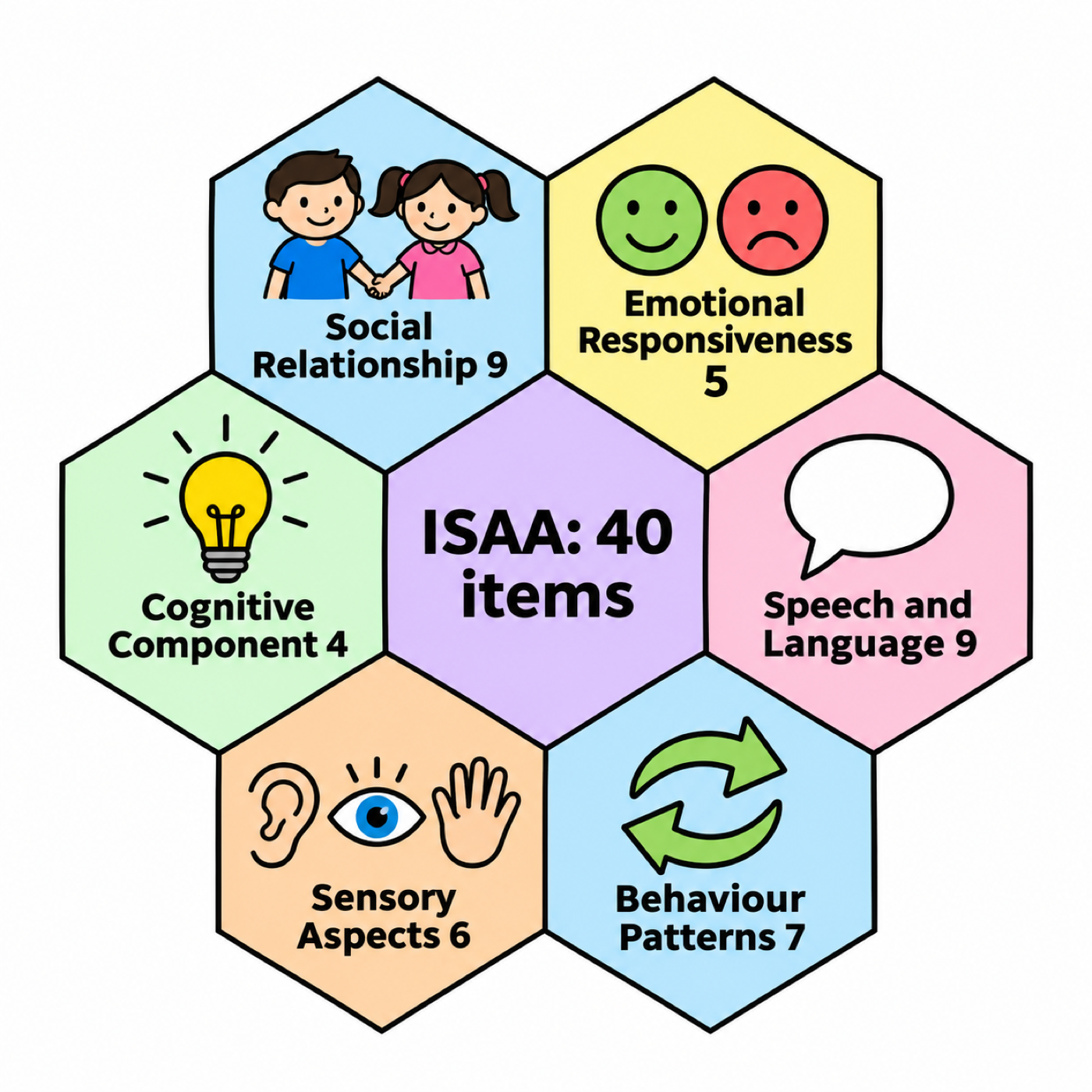
- It has 40 items in 6 domains:
| Domain | Items |
|---|---|
| 1. Social Relationship and Reciprocity | 9 |
| 2. Emotional Responsiveness | 5 |
| 3. Speech - Language and Communication | 9 |
| 4. Behaviour Patterns | 7 |
| 5. Sensory Aspects | 6 |
| 6. Cognitive Component | 4 |
| Total | 40 |
- Each item is rated on a 5-point scale. The score depends on how intense and how frequent the behaviour is:
| Score | How often |
|---|---|
| 1 | Rarely (up to 20%) |
| 2 | Sometimes (21-40%) |
| 3 | Frequently (41-60%) |
| 4 | Mostly (61-80%) |
| 5 | Always (81-100%) |
- For scoring, information is taken from the parents as well as from direct observation of the child. Items in the speech and language domain should be rated according to the guidelines in the manual.
- The total score ranges from 40 to 200. A higher score means more symptoms and a more severe presentation. Categories are suggested by score:
| ISAA total score | Category |
|---|---|
| Below 70 | No autism |
| 70 - 106 | Mild autism |
| 107 - 153 | Moderate autism |
| Above 153 | Severe autism |
Previous papers questions asked in the exam on what you just read
To assess Autism, this test is to be administered
- (1)BERA
- (2)BLOOD
- (3)ISAA
- (4)GLAD
Answer & explanation
Correct answer: (3) ISAA
The question asks which test is used to assess autism.
ISAA stands for Indian Scale for Assessment of Autism. It is a rating scale developed in India to measure the severity of autism. Its items cover social relationships, emotional response, speech and language, behaviour, sensory response and attention. The disability certificate for autism is issued on the basis of the ISAA score.
So the answer is option (3), ISAA.
BERA (1), Brainstem Evoked Response Audiometry, tests hearing. A blood test (2) cannot diagnose autism; autism is identified by observing behaviour. GLAD (4) is a tool for identifying learning disabilities.
Remember: ISAA = autism, BERA = hearing, GLAD = learning disability.
ISAA test is to be administered to assess children with
- (1)Deaf
- (2)Blind
- (3)Haemophilia
- (4)Autism
Answer & explanation
Correct answer: (4) Autism
The question asks which children are assessed with the ISAA test.
ISAA stands for Indian Scale for Assessment of Autism; the name itself contains the answer. It has 40 items that observe the child in six areas: social relationship and reciprocity, emotional responsiveness, speech-language and communication, behaviour patterns, sensory aspects and cognitive component. The total score shows whether the child has autism and how severe it is, and the scale is used for disability certification. So the answer is option (4), autism.
Deafness is measured by audiometry, so option (1) is wrong. Blindness is assessed with vision tests such as the Snellen chart, so option (2) is wrong. Haemophilia is diagnosed with blood tests, so option (3) is wrong.
Remember: ISAA = autism; audiometry = ear; Snellen chart = eye.
Expand ISAA and Number of items in that scale.
- (1)Indian scale for assessment of Autism, 42 items.
- (2)Informal scale for assessment of Autism, 65 items.
- (3)Intelligence scale for assessment of Autism, 35 items.
- (4)Indian scale for assessment of autism, 45 items.
Answer & explanation
Correct answer: (1), (4) get full marks (official key)
The official key gave marks for both (1) and (4); the board's note says there is ambiguity in the question or its answers. The question asks for the full form of ISAA and the number of items in the scale.
ISAA stands for Indian Scale for Assessment of Autism. It is the Indian tool used to identify autism and rate its severity, and it is the scale used for autism disability certification. It has 40 items grouped into 6 domains: social relationship and reciprocity, emotional responsiveness, speech-language and communication, behaviour patterns, sensory aspects, and cognitive component. Each item is rated on a 5-point scale.
Both (1) and (4) give the correct full form, but neither item count is right: the scale has 40 items, not 42 or 45. That is why both options were credited. Of the two, 42 is closer to the real number, so (1) is slightly stronger.
Options (2) 'Informal' and (3) 'Intelligence' expand the 'I' wrongly; in ISAA it stands for 'Indian'. These do not get marks.
Remember: ISAA = Indian Scale for Assessment of Autism: 40 items, 6 domains.
INDT-ASD - INCLEN Diagnostic Tool for Autism Spectrum Disorder
- A diagnostic tool developed in India by INCLEN.
- Used by trained persons; based on both the history from the primary caregivers and direct observation of the child.
- For children aged 2 to 9 years. It was validated against the DSM-IV-TR criteria and found to have a sensitivity of 98% and a specificity of 95%.
- It works equally well in pre-school (below 6 years) and primary school (6 years and above) children.
- Besides English, it is available in many Indian languages such as Hindi, Malayalam, Oriya, Konkani, Urdu, Khasi, Gujarati and Telugu; it is culturally suited to India.
- This tool, too, is approved by the Government of India for diagnosing autism for disability certification.
ADCL - Autism Diagnostic Checklist
- Banerjee, 2007.
- 60 items in 6 subscales; available in English and Bengali versions.
- It diagnoses autism and assesses which specific area is impaired, which helps in planning a management programme.
| Indian tool | Who, when | Items / domains | Special feature |
|---|---|---|---|
| ISAA | NIMH, 2009 | 40 items, 6 domains | 5-point rating; score 40-200; used for certification |
| INDT-ASD | INCLEN | History + direct observation | 2-9 years; in many Indian languages |
| ADCL | Banerjee, 2007 | 60 items, 6 subscales | English, Bengali |
Exam focus: ISAA = Indian Scale for Assessment of Autism (not "Intelligence" or "Informal"); NIMH 2009; 40 items, 6 domains, 5-point scale; score 40-200; below 70 = no autism. ISAA is for autism - not BERA (hearing) or Raven's Matrices (intelligence). INDT-ASD = 2-9 years. ADCL = Banerjee 2007, 60 items.
Memory code: "ISAA = 40 - 6 - 5" - 40 items, 6 domains, 5-point scale. Items per domain in order: "9-5-9-7-6-4" (social 9, emotional 5, language 9, behaviour 7, sensory 6, cognitive 4). Score cut-offs "70 - 107 - 153".