No single specialist can get the full picture of a child with autism. Information must be collected from different professionals, each with special knowledge of one aspect of the child and the family. Only then is effective service planning possible.
Professionals involved in autism assessment
- Psychologists
- Psychiatrists
- Neurologists
- Paediatricians and other physicians
- Speech pathologists
- Audiologists
- Occupational therapists
- Social workers
- Behavioural and educational specialists (special educators)
Interdisciplinary assessment
- It needs respect, integration and coordination among professionals from different backgrounds.
- It is the preferred model for the evaluation and assessment of autism.
- Each professional gives special information about his own area of the child's development and family functioning.
- Its defining feature: the whole team discusses together and integrates and synthesises everyone's information in one place. Each member knows that his interpretation is part of the whole picture, and conclusions and recommendations come from the combined effort of all.
Multidisciplinary assessment
- The child and family have to attend many sessions; this may even go on for several months.
- Professionals test separately, without working with the other members, and reach separate conclusions based on their own experience.
- It is a highly stressful process for children and families.
- The information collected is often repeated (redundant); one member's results may not reach another member when needed.
- Because there is no relationship with a fellow professional, or because of doubts about his knowledge / conclusions, parts of earlier tests are done again, ignoring the information already available.
| Point | Interdisciplinary | Multidisciplinary |
|---|---|---|
| Way of working | Discussion and coordination as a team | Each one separately |
| Conclusions | One combined conclusion and recommendations | A different conclusion from each |
| Information | Integrated and synthesised in one place | Repeated; not available in time |
| Effect on family | Less burden | Highly stressful; many sessions over months |
| For autism | Preferred model | More drawbacks |
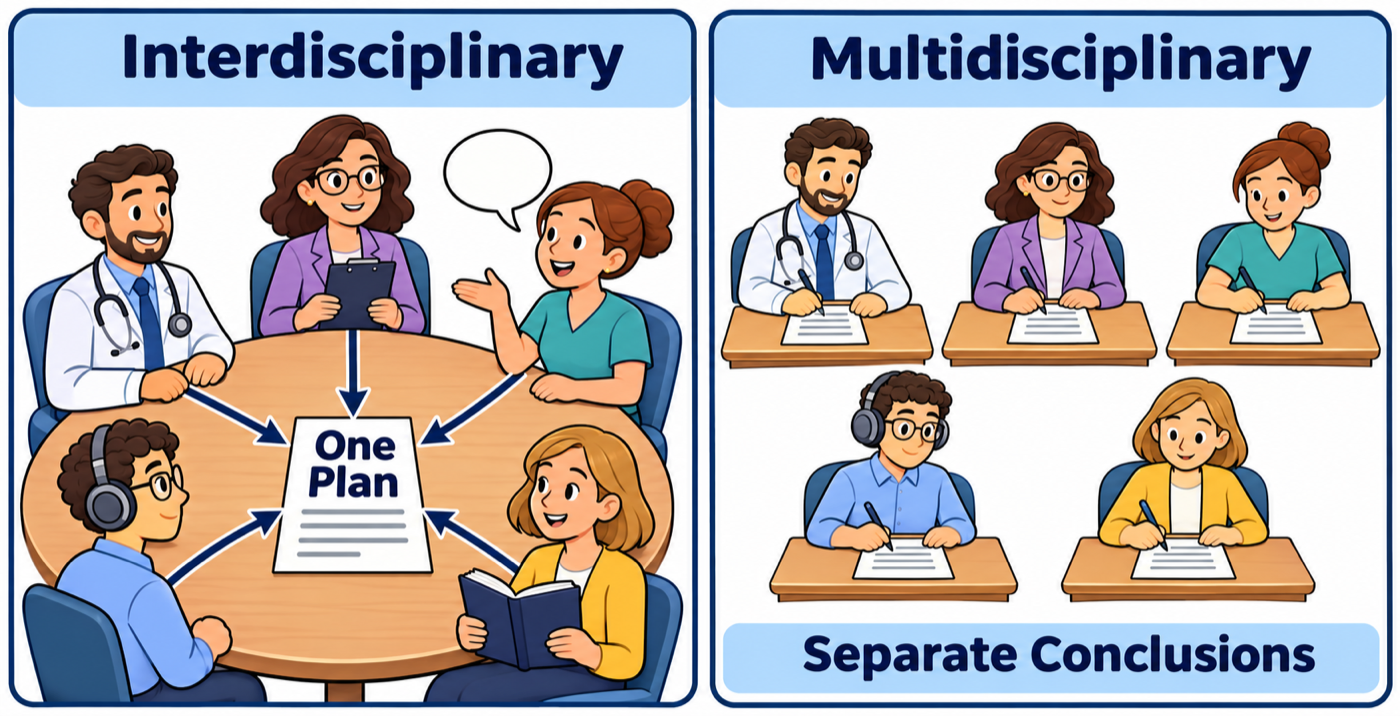
Exam focus: The preferred model for autism assessment = interdisciplinary; its defining feature is the team integrating and synthesising information together. Multidisciplinary = separate conclusions, redundant information, stress for the family.
Memory code: "Inter = one table, Multi = many tables" - in the interdisciplinary model everyone sits together at one table; in the multidisciplinary model each has his own table.