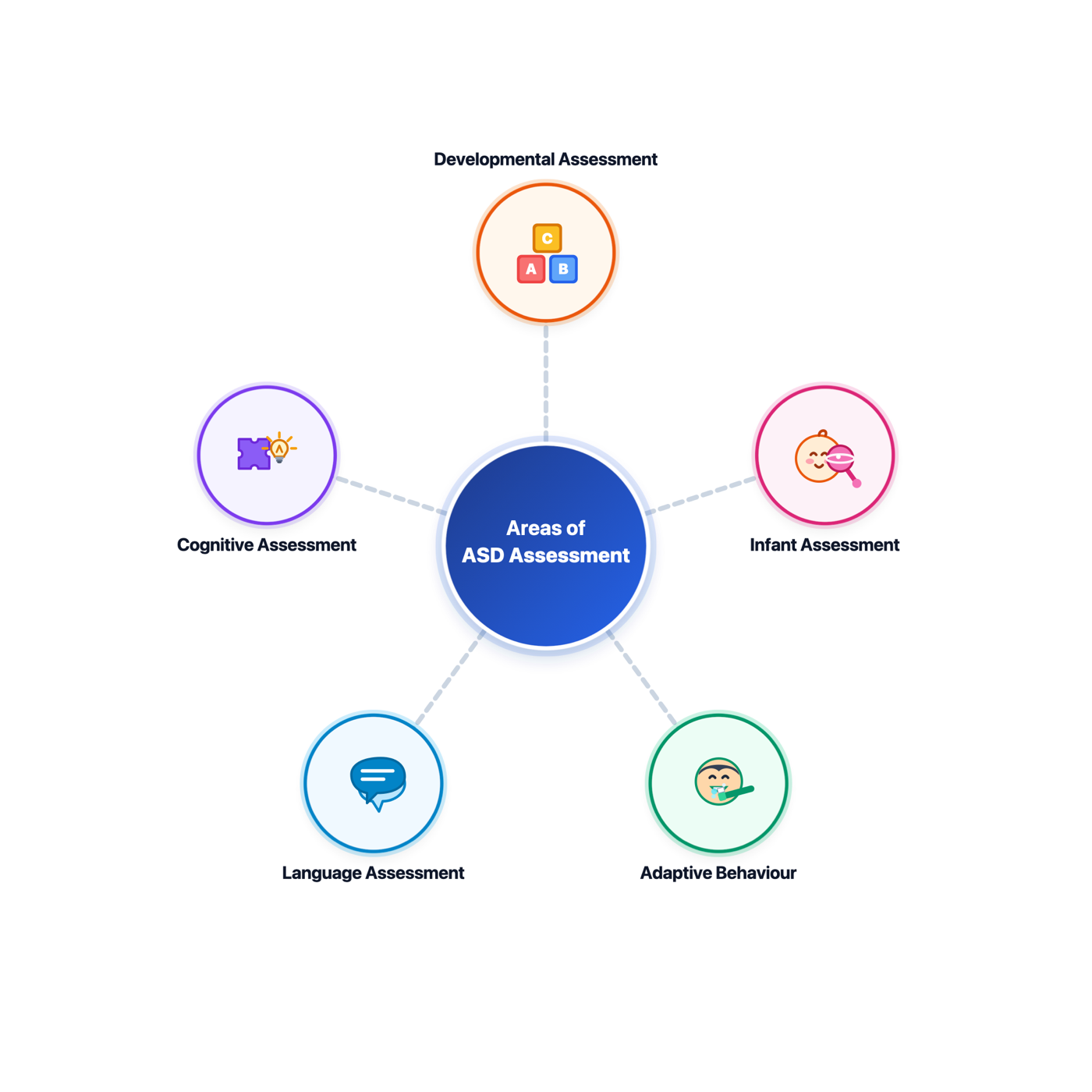
In children with autism, deficits in communication and social abilities and repetitive behaviours can be identified. Assessment is based on these areas. The main areas of assessment are:
- Developmental assessment
- Assessment of infants / toddlers
- Adaptive behaviour assessment
- Communication (language) assessment
- Cognitive assessment
Developmental assessment
- Developmental assessment needs great care. The child's developmental status must be understood, and his clusters of strengths and needs identified.
- Early development is a complex matter that covers many domains (mental, social and emotional development, language) at once.
- Tools such as the Psycho-Educational Profile - Revised (PEP-R) are used to learn the child's particular pattern.
- Developmental assessment is designed to identify the uneven, individual learning pattern of children with autism. A list of behaviours and skills is also part of it.
- When screening pre-primary / primary children, play, sensory responses and interest in language development should be brought out.
Assessment of infants / toddlers
- Bayley Scales of Infant Development (BSID-2) - introduced in 1993.
- Used to assess delays in the cognitive or motor skills of children with autism, and their needs, and to identify children who need intervention.
- 3 parts: Mental Scale, Motor Scale, Behaviour Rating Scale (earlier called the "Infant Behaviour Record"). The Mental Scale score is called the Mental Development Index.
- Mental Scale: sensory-perceptual abilities, object permanence, memory, learning, problem solving, beginnings of speech, language, early number concepts.
- Motor Scale: body control, large-muscle coordination, fine motor skills, imitation of postures, quality of movement.
Adaptive behaviour assessment
- Adaptive behaviour is the ability to meet personal needs and to respond to social expectations in the natural and social environment. It is the set of skills that helps a person function well every day at home, at school, at work and in the community.
- After assessment, a suitable environment is decided and these skills are developed.
- Vineland Adaptive Behavior Scales - Sparrow, Balla and Cicchetti, 1984.
- Areas assessed: communication, daily living skills, socialisation, motor skills, maladaptive behaviour.
- It has 3 forms. The child's behaviour is assessed by scoring the information given by parents, teachers or caregivers.
Communication (language) assessment
- The approach to communication assessment was developed by Bloom and Lahey (1978). It tells us about the language development of children with autism and their skill in conversing with others; the communication deficit of children with autism is examined in depth.
- Reynell Developmental Language Scales - Reynell, 1987; used to test the language development of children up to 7 years. It measures both receptive language and expressive language, and examines problems of language delay.
Cognitive assessment
- In his first descriptions, Leo Kanner (1943) believed that the general intelligence of children with autism was not impaired and was often superior. He thought so because these children showed very specific "splinter skills" such as counting and rote memory.
- Later studies proved again and again that the variation in the cognitive ability of children with autism is very great. Even among children with normal / superior non-verbal skills, a significant share have speech and adaptive skills at a deficient level.
- It is now recognised that assessing cognitive functioning is crucial for separating autism from other disabilities. Its role in prognosis and intervention planning is also important.
3 reasons for assessing ability:
| Reason | Explanation |
|---|---|
| 1. Differential diagnosis and intervention planning | The level of functioning, including cognitive + adaptive evaluation, matters. An ASD diagnosis is suitable only when the communication, social and interest deficits do not match the child's overall cognitive level. For example, a 4-year-old functioning at a 12-month developmental level who shows communication and play like other 12-month-olds is not given an ASD diagnosis. Below this level it is very hard to record significant social and communication deficits |
| 2. Response to treatment | Research shows that response to various treatment approaches is partly linked to overall cognitive functioning. For example, some intensive behavioural approaches were less successful in children at a low cognitive level with little chance of developing speech |
| 3. Rate of progress | The level of cognitive functioning may indicate the rate of progress to expect; this depends on how accurately the cognitive deficit can be determined |
Three cognitive theories to keep in mind during assessment
Three neuro-cognitive theories that explain the thinking style of children with autism tell us what to look for during assessment:
| Theory | Meaning | What to observe in assessment and in class |
|---|---|---|
| Theory of Mind | The ability to imagine other people's mental states - thoughts, beliefs, desires, intentions, feelings - and to know that they may differ from one's own | No two children are alike; the teacher should observe each child's state of mind, look into his eyes and teach in an interesting way he can understand. Children with autism sometimes prefer to stay alone without mixing with anyone |
| Central Coherence | The ability to put details together and understand the whole picture and context; in autism this is weak (focus only on details) | Negative attitudes in society towards children with autism should be removed; people should be told that understanding feelings, emotions and social situations is hard for them, and that this is due to weak central coherence |
| Executive Function | The ability to set a goal, plan, use past and present experience, and solve a problem step by step; this is deficient in autism | Evaluate how the child solved the problem and whether he reached the goal, find out what level he is at and change the plan; if needed, start again from the first step |
Exam focus: BSID-2 (Bayley) = 1993, mental + motor + behaviour rating scales. Vineland = Sparrow, Balla, Cicchetti 1984; adaptive behaviour, 3 forms. Communication assessment = Bloom and Lahey 1978. Reynell = 1987, up to 7 years, receptive + expressive language. Because of splinter skills, Kanner (1943) thought their intelligence was good. Cognitive assessment is crucial for differential diagnosis.
Memory code: "Bayley 93, Vineland 84, Bloom 78, Reynell 87" - BSID-2 1993, Vineland 1984, Bloom-Lahey 1978, Reynell 1987. Vineland authors "SBC" - Sparrow, Balla, Cicchetti. The three theories "TCE" - Theory of Mind, Central Coherence, Executive Function.